For an overview of maritime plaques, click on the Maritime heading above. Click on images to enlarge.
Common ship transfers
By common, I meant that I'd seen more than seven plaques with these transfers in my first ten years of collecting. I've now seen considerably more, particularly of the first two. In fact, what these transfers mostly have in common is that they were in use from the 1850s onwards. The 'less common' and 'rare' transfers tend to be of later ships, post 1860, so their copper plates were in use for a shorter period.
There are other factors which have a bearing on rarity, e.g. the later brown-bordered Moore's plaques are more common than their pink-bordered counterparts. Pink-bordered plaques with the Moore & Co impress, are rarer still.
Contents of this page:
The Austrailian Clipper-Ship Marco Polo (unidentified pottery, Carr)
Northumberland 74 (Garrison)
Duke of Wellington – 131 Guns (Moore, Scott)
la Bretagne – 140 Guns (Moore, Scott)
Euryalus (Moore, Scott)
The Great Eastern Steam-Ship (Moore, Scott)
Victoria and Albert Yacht (Moore, Scott)
Unidentified common ships
There are other factors which have a bearing on rarity, e.g. the later brown-bordered Moore's plaques are more common than their pink-bordered counterparts. Pink-bordered plaques with the Moore & Co impress, are rarer still.
Contents of this page:
The Austrailian Clipper-Ship Marco Polo (unidentified pottery, Carr)
Northumberland 74 (Garrison)
Duke of Wellington – 131 Guns (Moore, Scott)
la Bretagne – 140 Guns (Moore, Scott)
Euryalus (Moore, Scott)
The Great Eastern Steam-Ship (Moore, Scott)
Victoria and Albert Yacht (Moore, Scott)
Unidentified common ships
The Australian Clipper-Ship Marco Polo

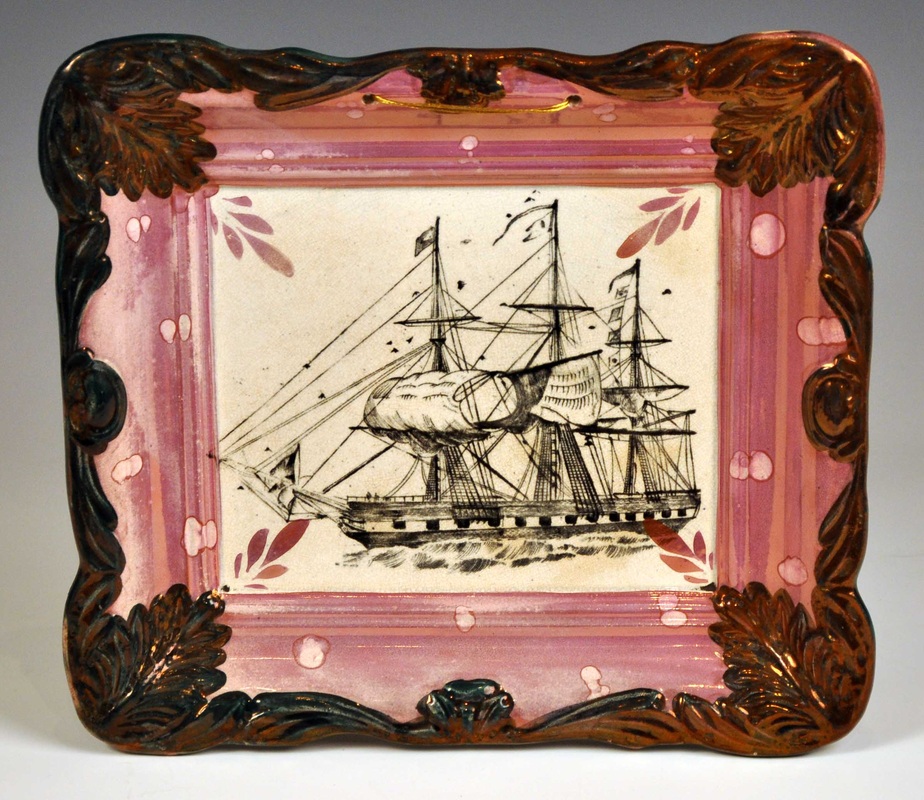
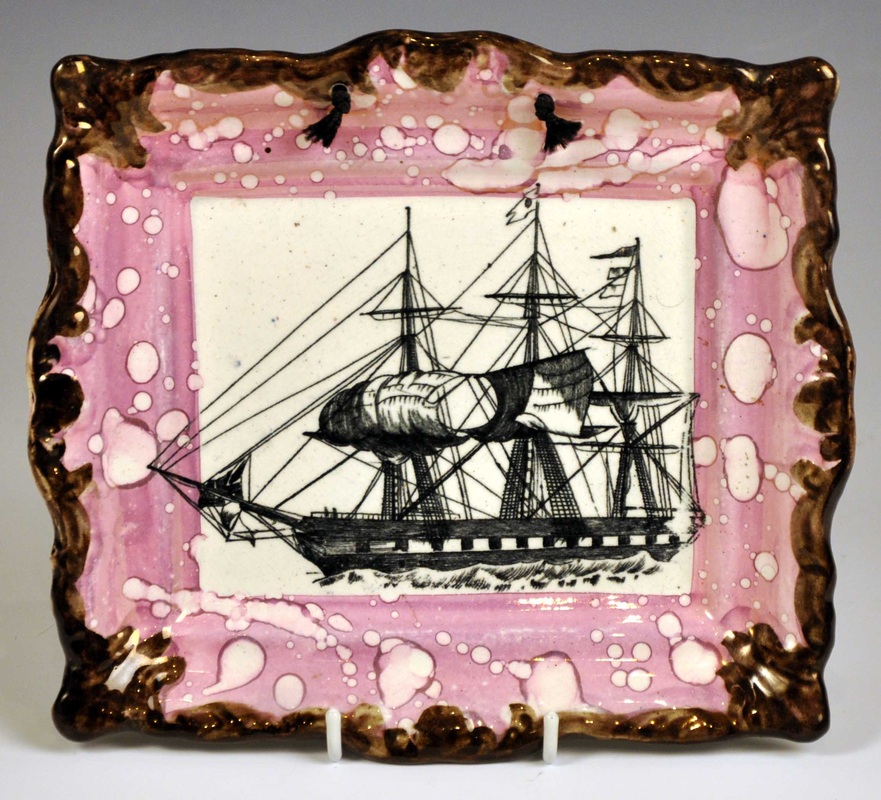
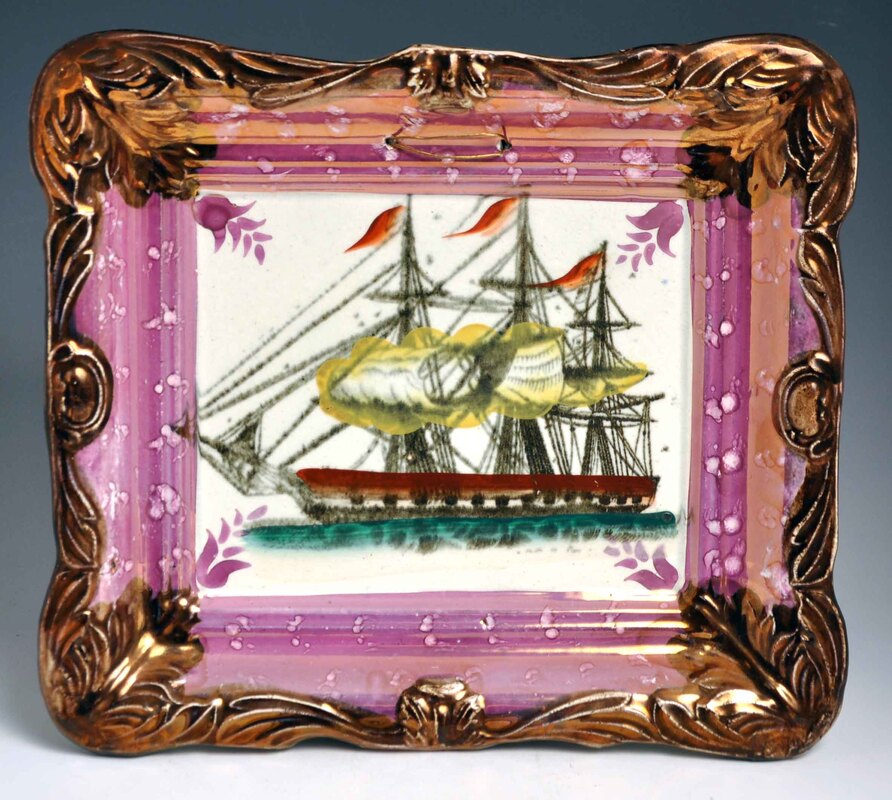
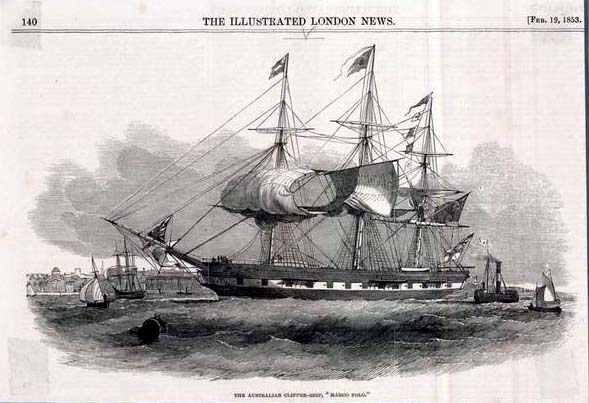
The Marco Polo was a three-masted wooden clipper ship, lauched in 1851 in New Brunswick (Canada). She was 184 feet long and had three decks. In 1851 the Marco Polo sailed to Liverpool, making the crossing in just 15 days. The next year she was purchased by the Black Ball Line and converted for passenger service between England and Australia. She made the first recorded round trip in less than 6 months (5 months 21 days). The illustration above presumably shows her triumphant return. In 1867 she was converted back to cargo use. On a trip from Quebec In July 1883, she sprung a leak north of Prince Edward Island and was deliberately grounded by her crew. A gale the following month caused her to break up. Today the wreck is a National Historic Site.
http://en.wikipedia.org/wiki/Marco_Polo_(ship)
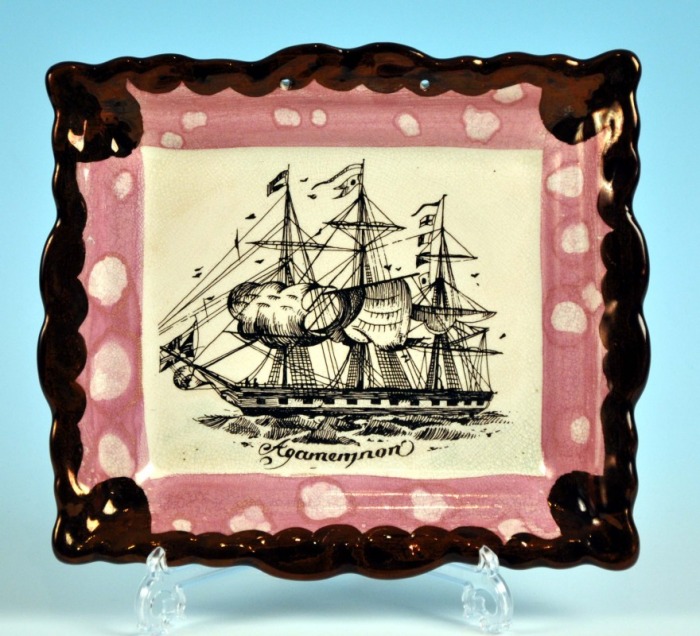
This transfer appears on smaller unmarked plaques, and larger plaques with rounded corners attributed to John Carr's pottery, Newcastle (top centre and bottom left). The popularity of these plaques plummeted when the marketplace was flooded with similar modern reproductions titled 'Agamemnon' (bottom right). Sadly these repros are often passed off as 19th century originals. See the Reproductions page to find out more.
See my other site for a survey of this transfer on jugs, bowls, etc.
http://en.wikipedia.org/wiki/Marco_Polo_(ship)
This transfer appears on smaller unmarked plaques, and larger plaques with rounded corners attributed to John Carr's pottery, Newcastle (top centre and bottom left). The popularity of these plaques plummeted when the marketplace was flooded with similar modern reproductions titled 'Agamemnon' (bottom right). Sadly these repros are often passed off as 19th century originals. See the Reproductions page to find out more.
See my other site for a survey of this transfer on jugs, bowls, etc.
Northumberland 74
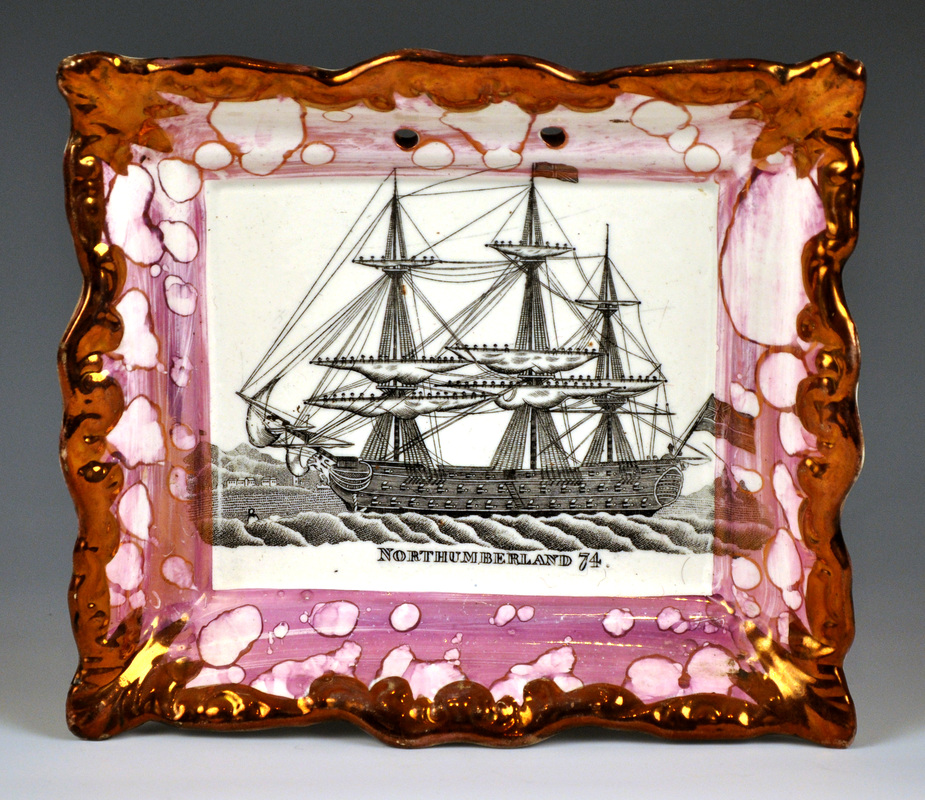
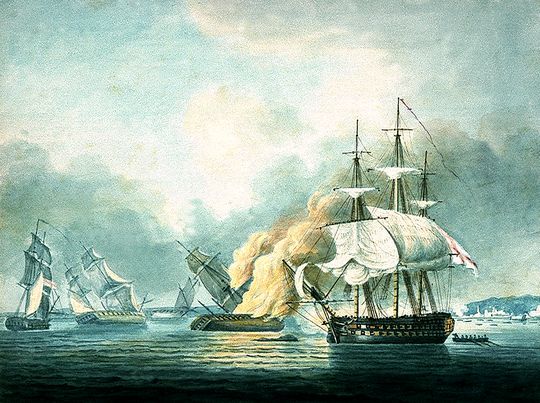
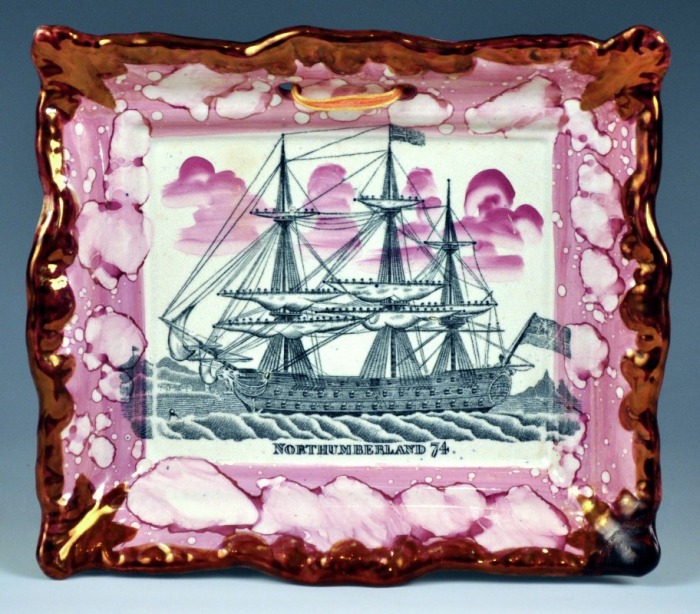


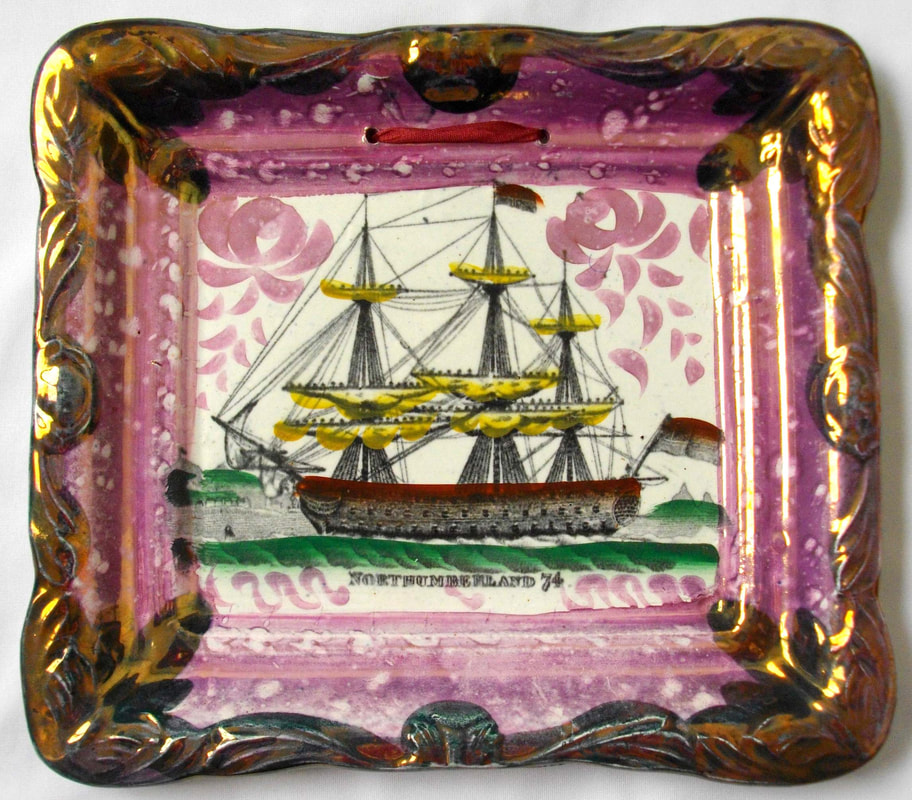
HMS Northumberland was a 74-gun third rate ship, built in Deptford and launched on 2 February 1798. She suffered heavy casualties in the Battle of San Domingo, 1806. On 22 November 1810, she, with HMS Armada, captured the French ketch La Glaneuse. In 1815, Northumberland transported Napoleon to captivity on the Isle of Saint Helena. She was broken up in 1850.
http://en.wikipedia.org/wiki/HMS_Northumberland_(1798)
Henrywood writes that this is probably the most common transfer of a named ship. Northumberland is much older than most of the named ships on plaques. The top left plaque has the 'Dixon, Phillips & Co' anchor mark (1839–c1850) and the top centre has the 'Dixon Co' mark (c1851–1865). The circular plaque is also from the Garrison Pottery (Dixon), and is much rarer (I've only seen one with this transfer). The last two plaques are attributed to John Carr's Low Lights Pottery. Carr apparently acquired the transfer plate when the Garrison Pottery closed in 1865. The Carr versions are rarer. The local connection of the ship might partly explain its popularity, Sunderland neighbouring the county of Northumberland.
See my other site for a comprehensive survey of this transfer on jugs, bowls, etc.
http://en.wikipedia.org/wiki/HMS_Northumberland_(1798)
Henrywood writes that this is probably the most common transfer of a named ship. Northumberland is much older than most of the named ships on plaques. The top left plaque has the 'Dixon, Phillips & Co' anchor mark (1839–c1850) and the top centre has the 'Dixon Co' mark (c1851–1865). The circular plaque is also from the Garrison Pottery (Dixon), and is much rarer (I've only seen one with this transfer). The last two plaques are attributed to John Carr's Low Lights Pottery. Carr apparently acquired the transfer plate when the Garrison Pottery closed in 1865. The Carr versions are rarer. The local connection of the ship might partly explain its popularity, Sunderland neighbouring the county of Northumberland.
See my other site for a comprehensive survey of this transfer on jugs, bowls, etc.
Duke of Wellington - 131 guns
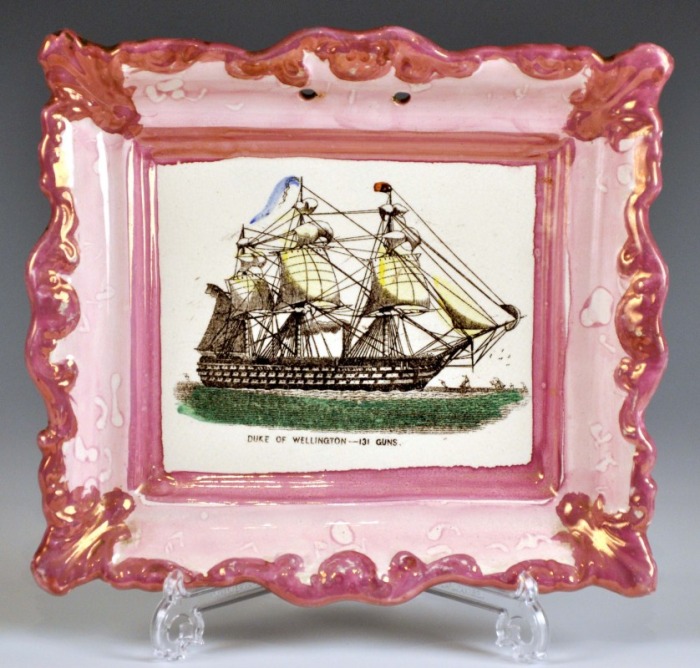
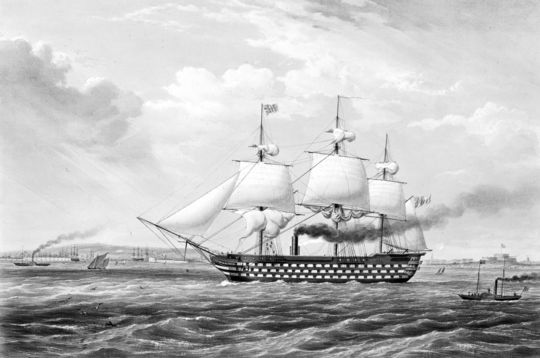
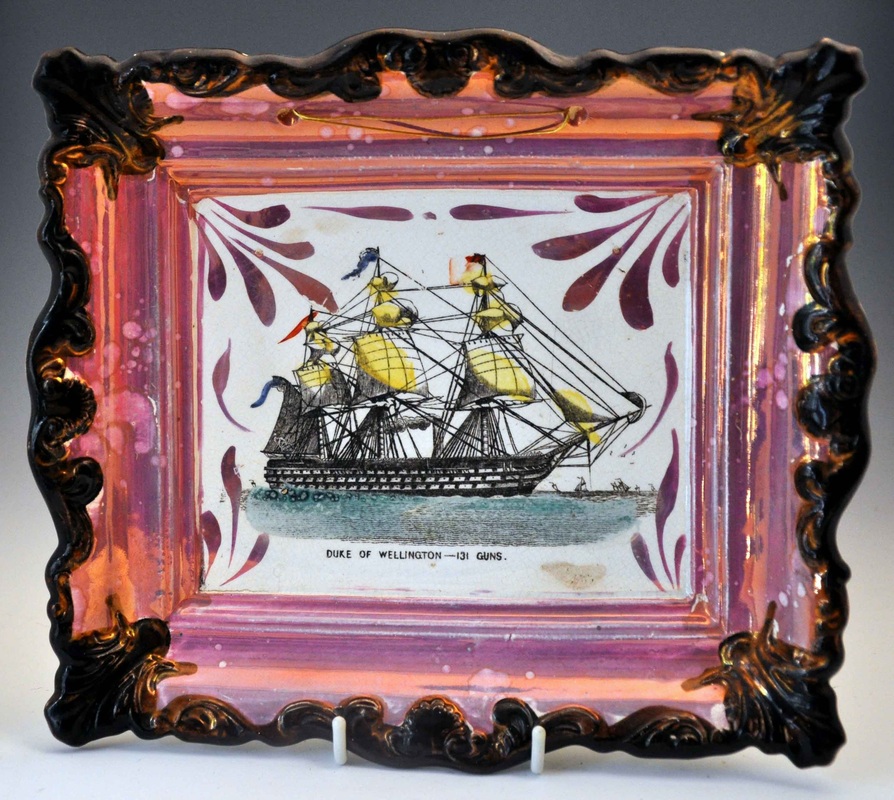

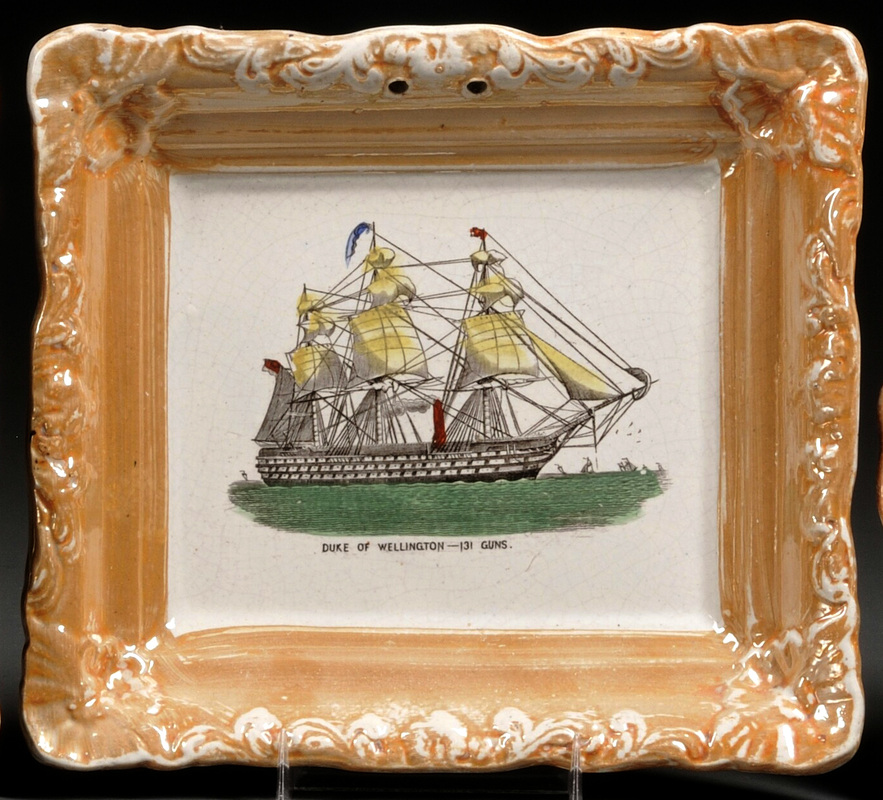
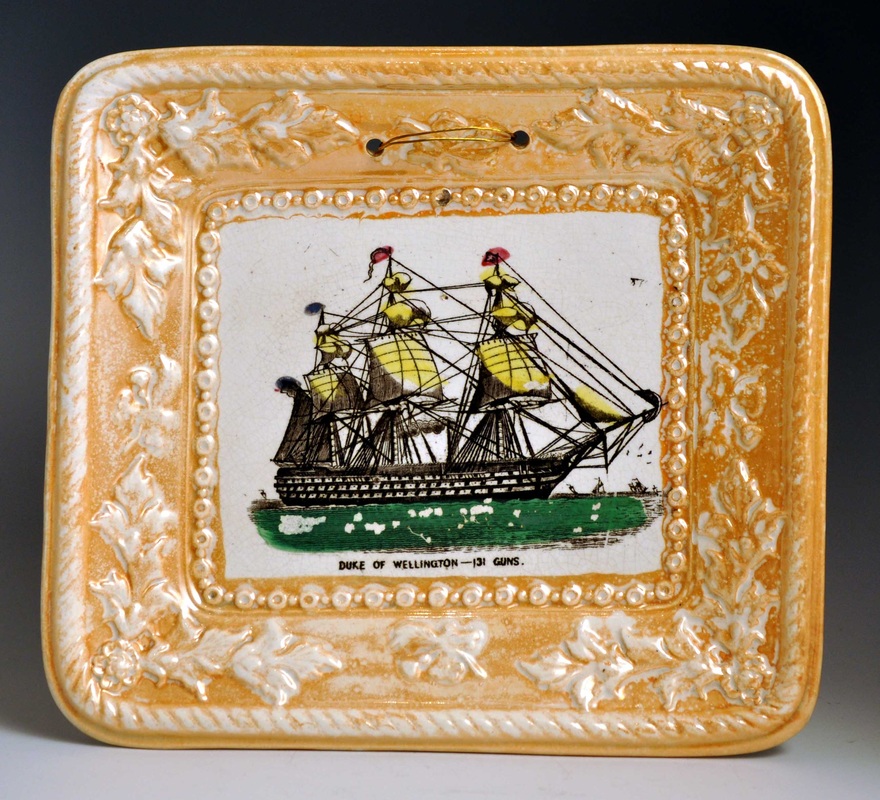
HMS Duke of Wellington - a wooden screw steam ship of 700 HP - was built in Pembroke Yard (Wales), and launched on 14 September 1852, the day the Duke of Wellington died. Originally christened the Windsor Castle, she was afterwards renamed in the Duke's honour. Her length was 240 ft 6 ins, breadth 60 ft 3 ins, and speed 10.675 knots. She was twice the size of Nelson's Victory, and on paper the most powerful warship in the world, until La Bretagne was launched in 1855. On 25 February 1854, she became the flagship of Vice-Admiral Sir Charles Napier and served in the Baltic, and in February 1855, the flagship of Rear-Admiral Richard Dundas. Because of structural problems (she was originally designed as a sail ship, but adapted during construction to incorporate a steam engine) she saw no active service after the Crimea, and was paid off in 1856.
http://en.wikipedia.org/wiki/HMS_Duke_of_Wellington
The transfer was first used in Moore & Co's Wear Pottery, c1855, to meet popular demand for Crimean War-related pottery, and pairs with LA BRETAGNE – 140 GUNS. The first plaque has a Moore & Co impressed mark. The second and third plaques are of a more common form, always unmarked. Although this plaque form is often attributed to Scott, my research suggests these plaques were more likely made by Moore's in the 1860s.
The transfer appears on later plaques with orange lustre borders (c1870s). The left orange plaque is of a form associated with Moore, and right of a form associated with Scott. It seems likely that during this period both potteries were sending items to nearby Sheepfolds Warehouse for decoration. The ship transfers from this series also appear on glass rolling pins associated with Sheepfolds.
See my other site for a comprehensive survey of this transfer on jugs, bowls etc.
http://en.wikipedia.org/wiki/HMS_Duke_of_Wellington
The transfer was first used in Moore & Co's Wear Pottery, c1855, to meet popular demand for Crimean War-related pottery, and pairs with LA BRETAGNE – 140 GUNS. The first plaque has a Moore & Co impressed mark. The second and third plaques are of a more common form, always unmarked. Although this plaque form is often attributed to Scott, my research suggests these plaques were more likely made by Moore's in the 1860s.
The transfer appears on later plaques with orange lustre borders (c1870s). The left orange plaque is of a form associated with Moore, and right of a form associated with Scott. It seems likely that during this period both potteries were sending items to nearby Sheepfolds Warehouse for decoration. The ship transfers from this series also appear on glass rolling pins associated with Sheepfolds.
See my other site for a comprehensive survey of this transfer on jugs, bowls etc.
La Bretagne - 140 guns
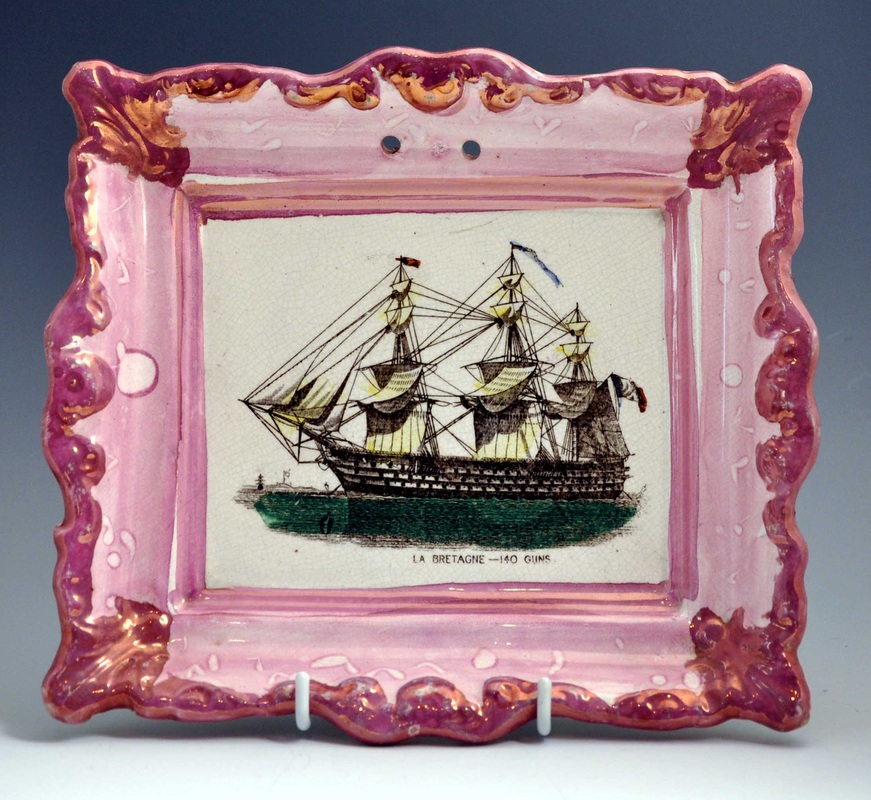


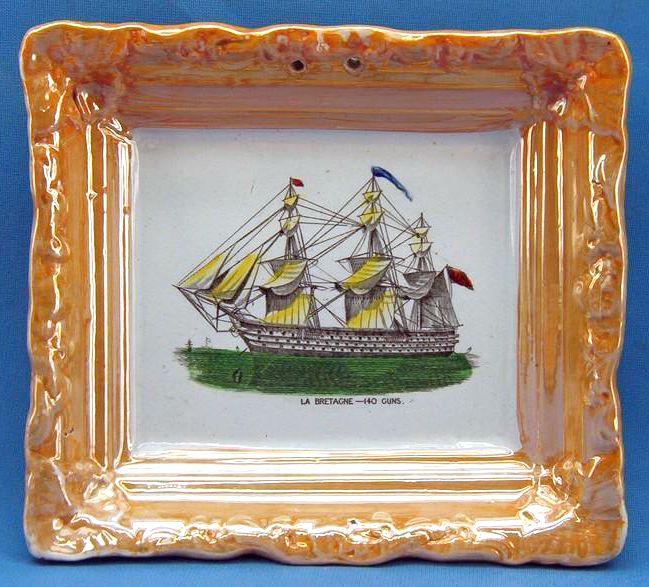
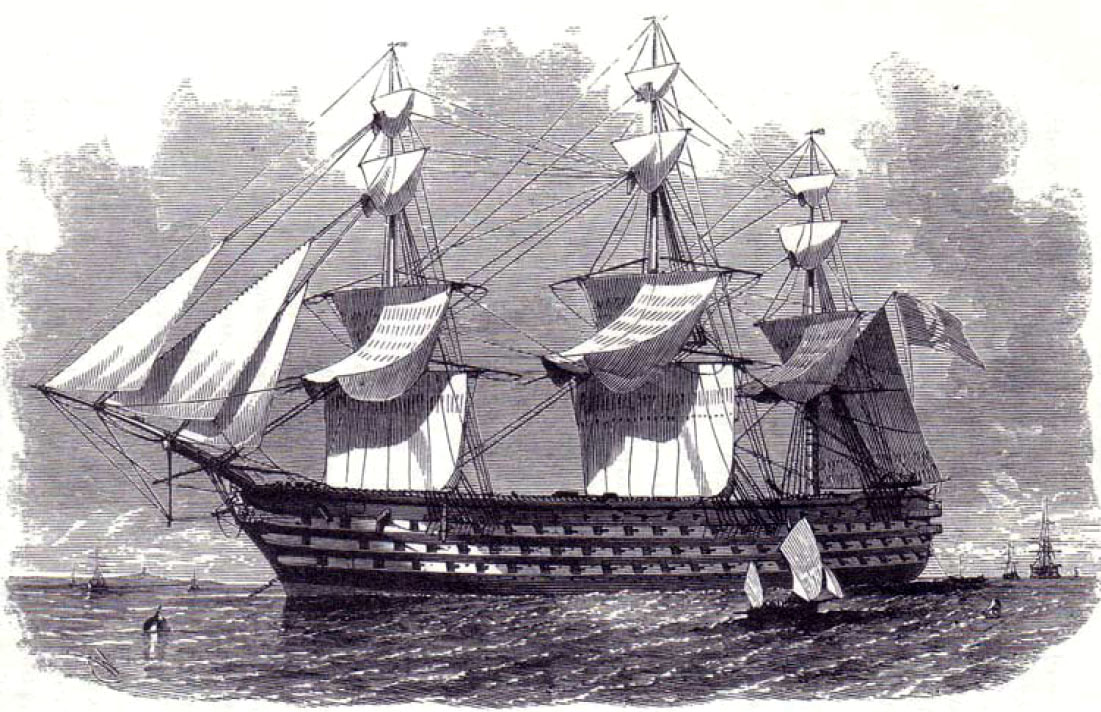
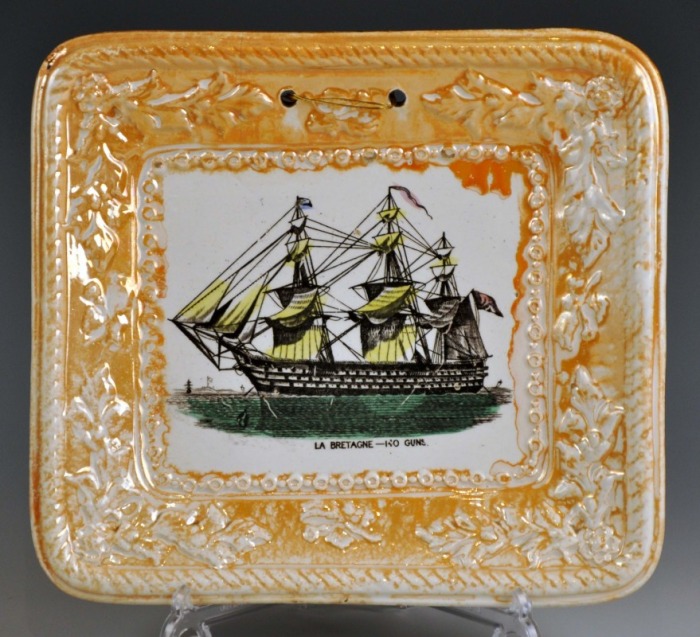
The Bretagne was a fast (12.6 knots) three-decker of the French Navy, designed by engineer Marielle, and launched on 17 February 1855. Though built after the Napoleon (the first purpose-built steam warship, launched in 1850), she was originally designed as a sail ship. Like the Duke of Wellington, a steam engine was added during construction. The Bretagne took part in the Crimean war in 1855. She was renamed to Ville de Bordeaux in 1880, and scrapped the same year.
http://en.wikipedia.org/wiki/French_ship_Bretagne_(1855)
The bottom centre image is the cover illustration of 'Naval Fleets of the World' c 1859, and shows L Bretagne drying her sails.
The transfer originated at Moore & Co's Wear Pottery in c1855. The first plaque has a Moore & Co impressed mark. The second plaque is later (c1860s), and of a more common form, also attributed to Moore's. The transfer appears on later plaques with orange lustre borders (c1870s), so was popular for a long period. The first orange plaque is of a form attributed to Moore, and the second to Scott.
See my other site for a comprehensive survey of this transfer on jugs, bowls etc.
http://en.wikipedia.org/wiki/French_ship_Bretagne_(1855)
The bottom centre image is the cover illustration of 'Naval Fleets of the World' c 1859, and shows L Bretagne drying her sails.
The transfer originated at Moore & Co's Wear Pottery in c1855. The first plaque has a Moore & Co impressed mark. The second plaque is later (c1860s), and of a more common form, also attributed to Moore's. The transfer appears on later plaques with orange lustre borders (c1870s), so was popular for a long period. The first orange plaque is of a form attributed to Moore, and the second to Scott.
See my other site for a comprehensive survey of this transfer on jugs, bowls etc.
Euryalus
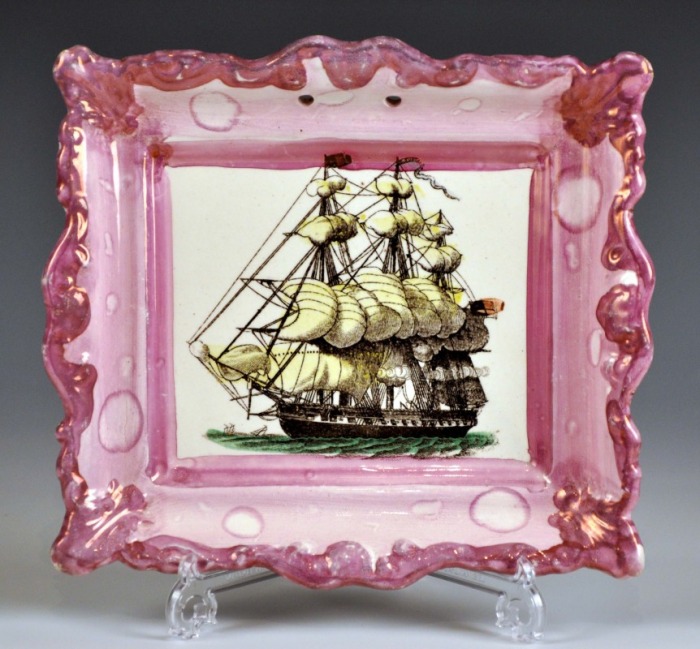
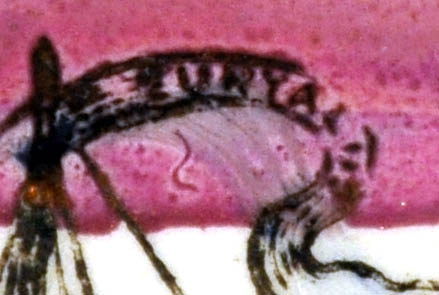
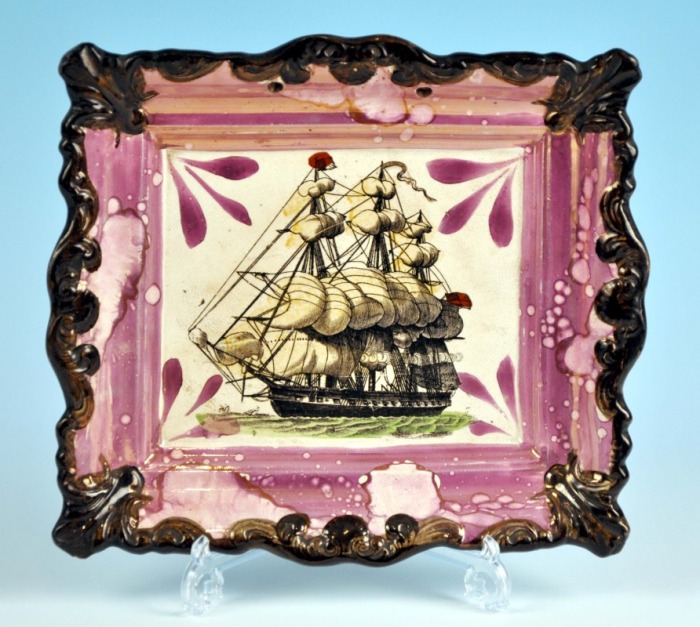
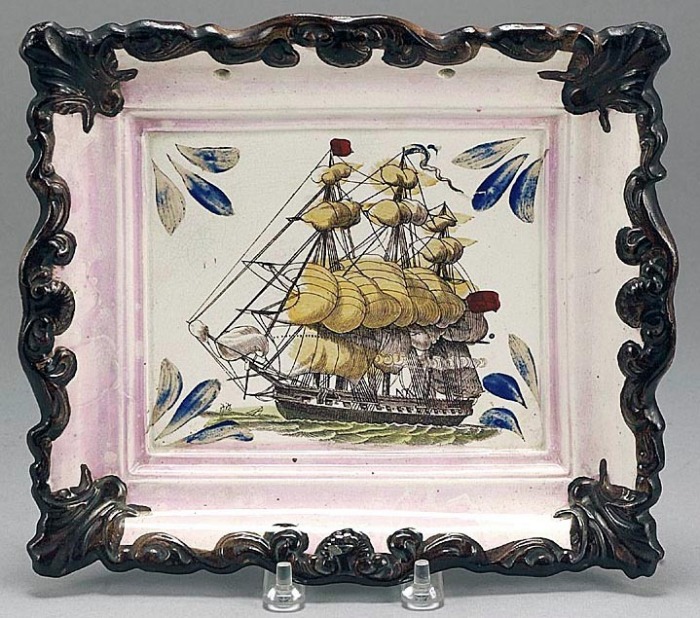
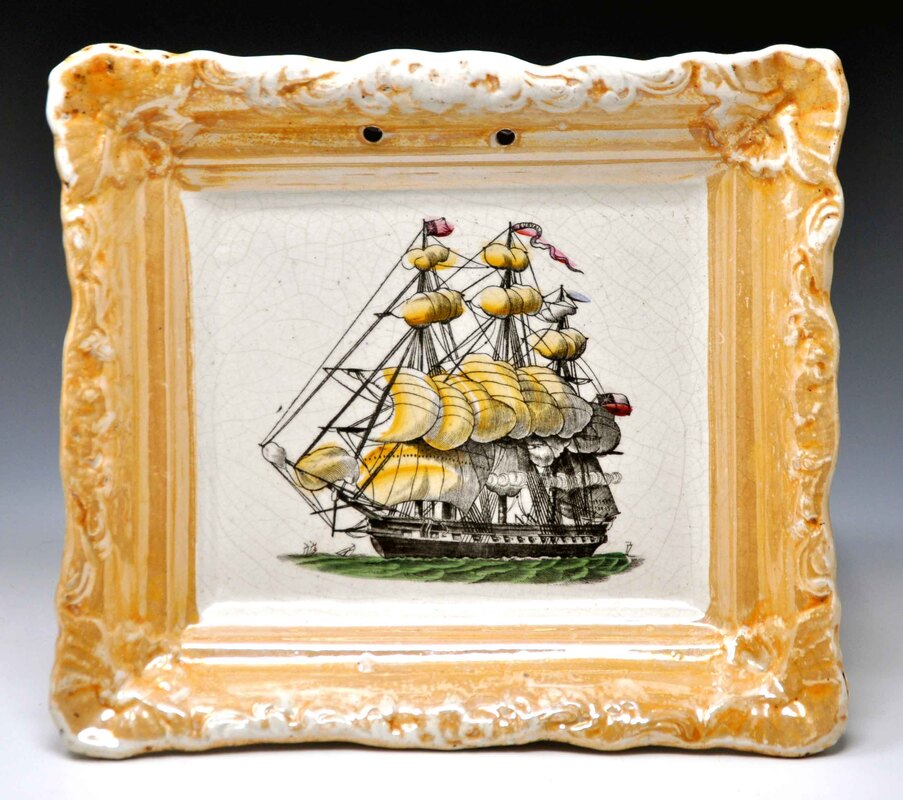
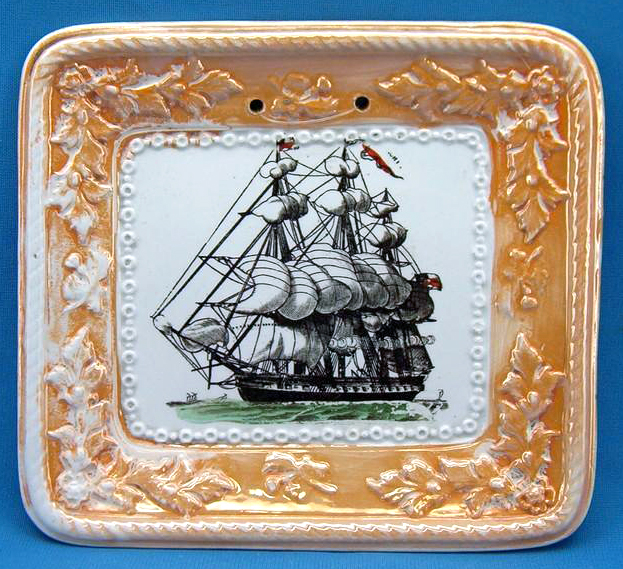
HMS Euryalus was a fourth-rate wooden-hulled screw frigate, with a 400 HP steam engine, which could make over 12 knots. Launched at Chatham in 1853, she was 212 feet long, and had a complement of 515 men. She arrived at Yokohama on 14 September 1862, the date of the Namamugi Incident. She served as Admiral Sir Augustus Kuper's flagship during the bombardment of Kagoshima in August 1863 and the bombardment of Shimonoseki in September 1864. At that time she carried 35 guns, and approximately 16 carronades. Euryalus was paid off at Portsmouth on 23 September 1865, and broken up in 1867.
http://en.wikipedia.org/wiki/HMS_Euryalus_(1853)
Though this transfer is untitled, the pennant flag on the centre mast bears the name Euryalus in small letters (see right above).
The first plaque, although unmarked, is typical of Moore's Wear Pottery, where the transfer likely originated in the mid 1850s. The other pink-lustre plaques are also attributed to Moore's, from the 1860s. The first orange-lustre plaque is of a form attributable to Moore's and the second is attributed to Scott's.
http://en.wikipedia.org/wiki/HMS_Euryalus_(1853)
Though this transfer is untitled, the pennant flag on the centre mast bears the name Euryalus in small letters (see right above).
The first plaque, although unmarked, is typical of Moore's Wear Pottery, where the transfer likely originated in the mid 1850s. The other pink-lustre plaques are also attributed to Moore's, from the 1860s. The first orange-lustre plaque is of a form attributable to Moore's and the second is attributed to Scott's.
The Great Eastern Steam-Ship


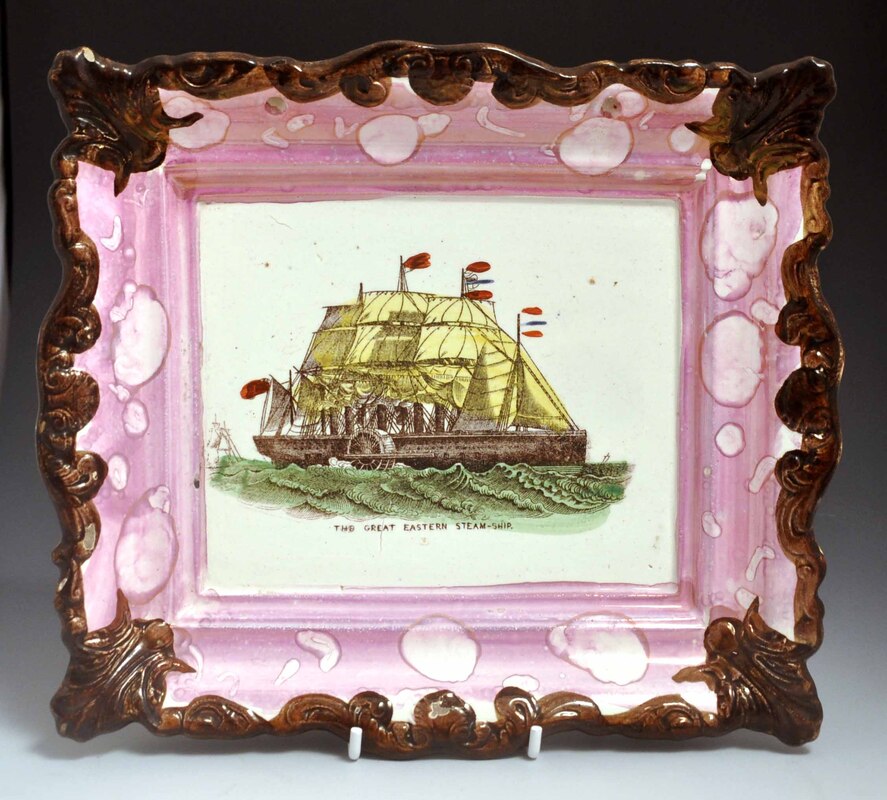
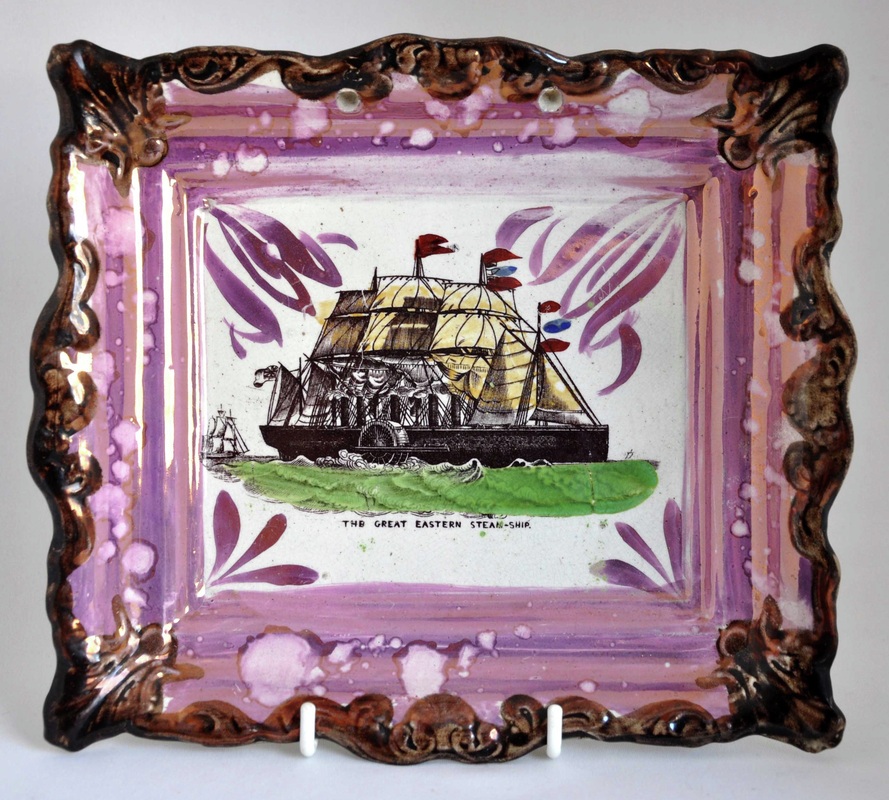
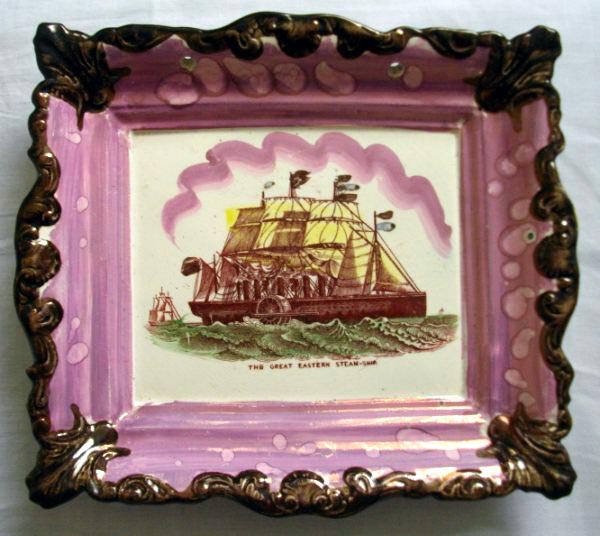
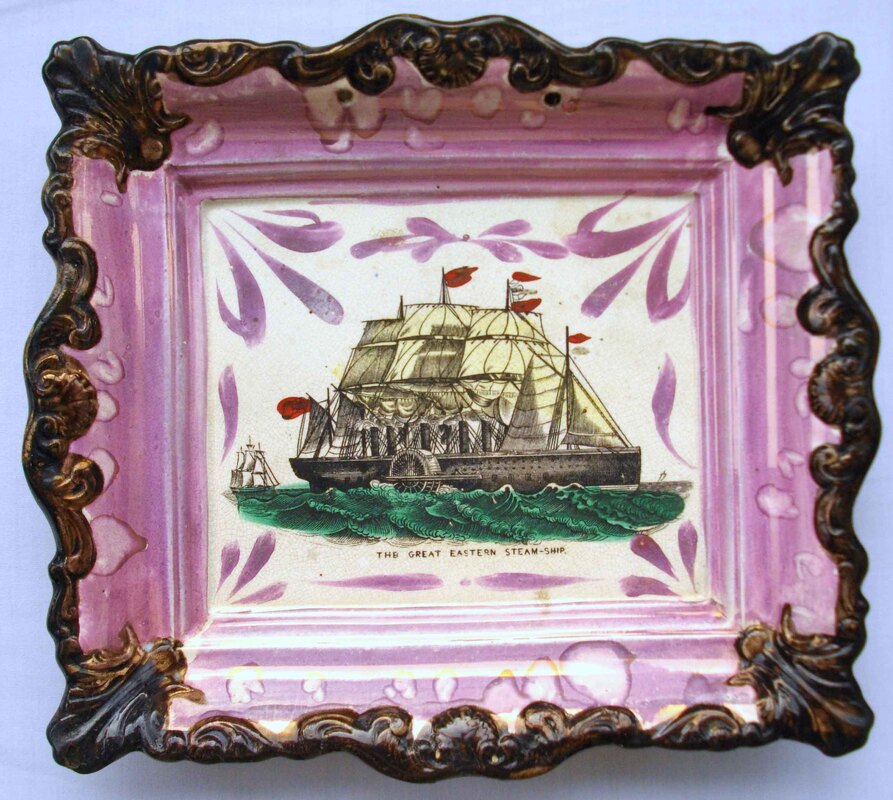
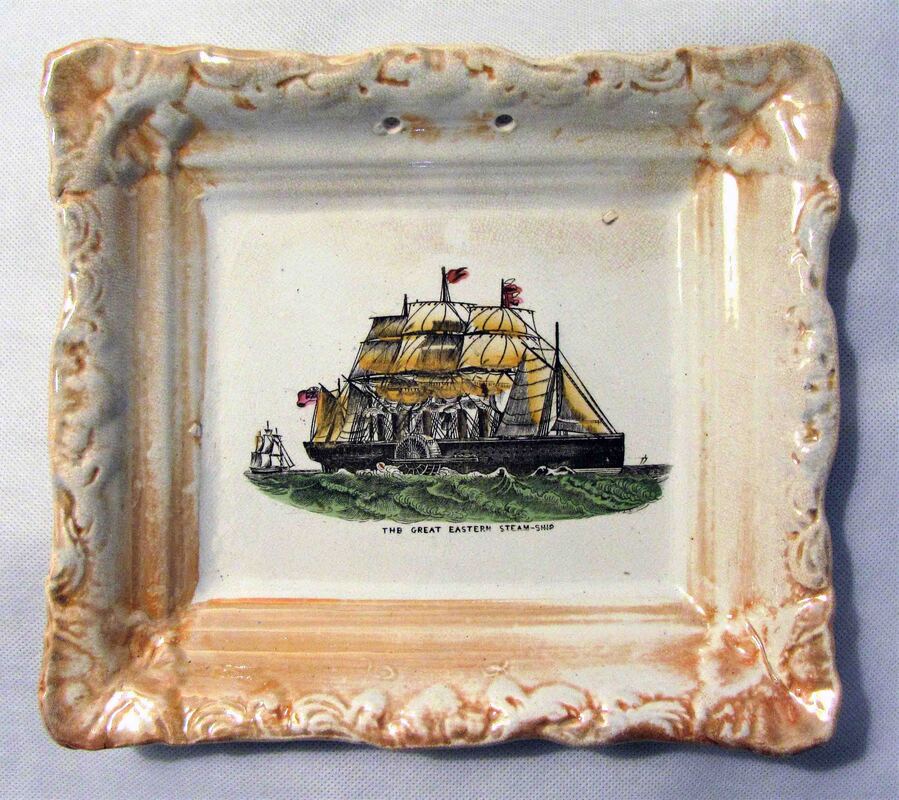
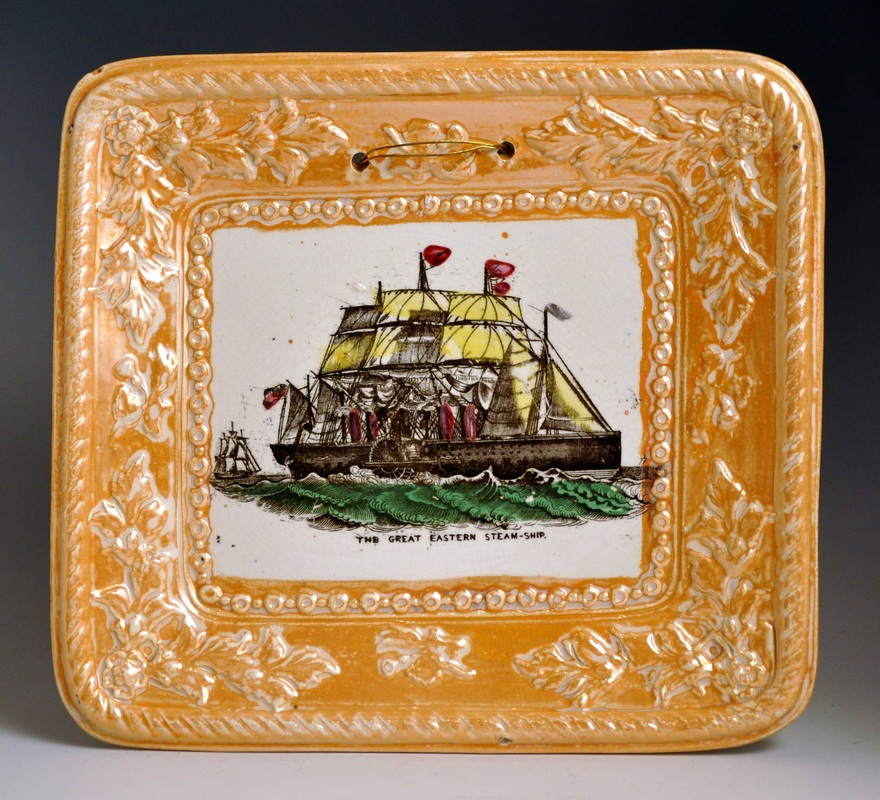
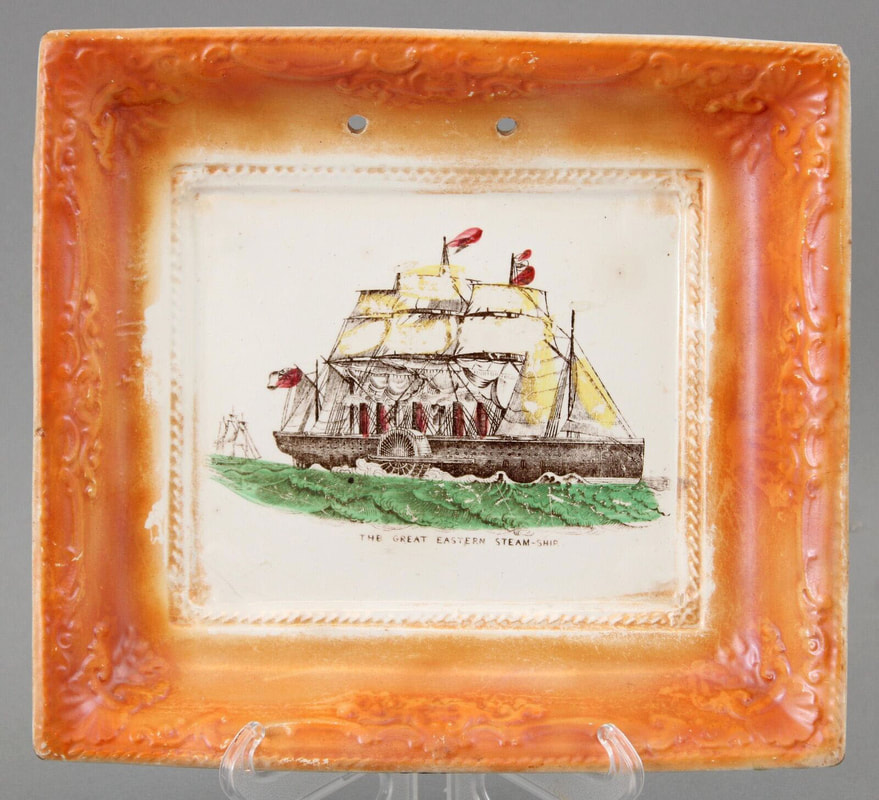
The SS Great Eastern was an iron sailing steam ship designed by the great engineer Isambard Kingdom Brunel. Designed to carry 4,000 passengers, she was by far the largest ship ever built at the time of her launch in 1858. Her length was 692 feet, and her maximum speed 13 knots. In an ill-fated maiden voyage, she was damaged by an explosion. After repairs, she worked for several years as a passenger liner between Britain and America. In 1865 she worked as a trans-Atlantic cable-laying ship. She finished her life as a floating music hall, and was broken up in 1889. For more information, click on the links below.
http://en.wikipedia.org/wiki/Ss_great_eastern
http://www.brunel200.com/ss_great_eastern.htm
http://www.atlantic-cable.com/Cableships/GreatEastern/
The plaque shows the foreshortened view used on the Great Eastern's promotional material (top centre). It seems likely that this transfer originated in Moore's Wear Pottery c1858. The first plaque, although unmarked, is typical of 1850s' plaques from that pottery. The other pink-lustre plaques are later, 1860s, and also attributed Moore's. The transfer was used over a long period and appears on later orange-bordered plaques attributed to both Moore's and Scott's.
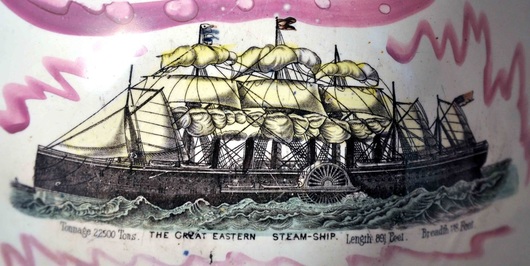
A larger transfer of this ship (below) appears on bowls marked 'Moore', and likely on bowls marked 'Scott' also. It is too large to fit comfortably on a plaque. Read more here on my Sunderland pottery transfers site.
http://en.wikipedia.org/wiki/Ss_great_eastern
http://www.brunel200.com/ss_great_eastern.htm
http://www.atlantic-cable.com/Cableships/GreatEastern/
The plaque shows the foreshortened view used on the Great Eastern's promotional material (top centre). It seems likely that this transfer originated in Moore's Wear Pottery c1858. The first plaque, although unmarked, is typical of 1850s' plaques from that pottery. The other pink-lustre plaques are later, 1860s, and also attributed Moore's. The transfer was used over a long period and appears on later orange-bordered plaques attributed to both Moore's and Scott's.
A larger transfer of this ship (below) appears on bowls marked 'Moore', and likely on bowls marked 'Scott' also. It is too large to fit comfortably on a plaque. Read more here on my Sunderland pottery transfers site.
Victoria and Albert Yacht
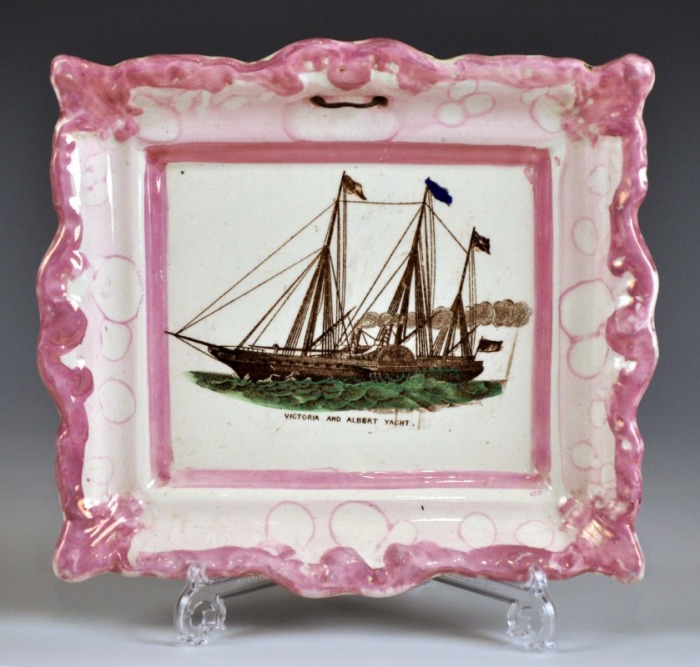
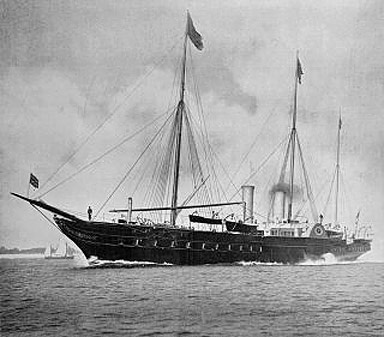
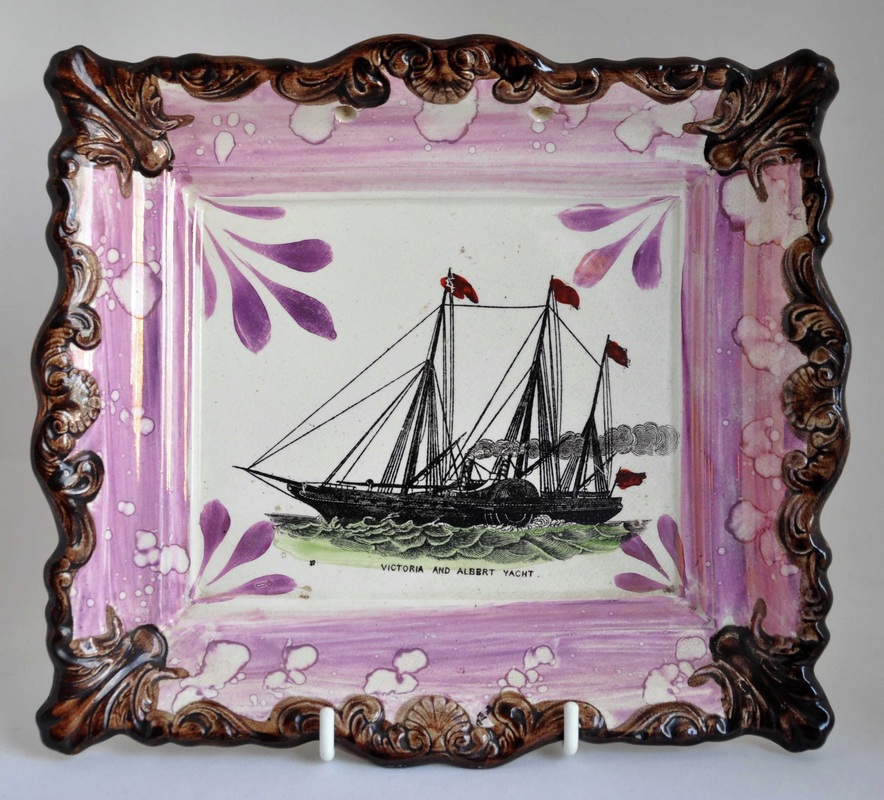
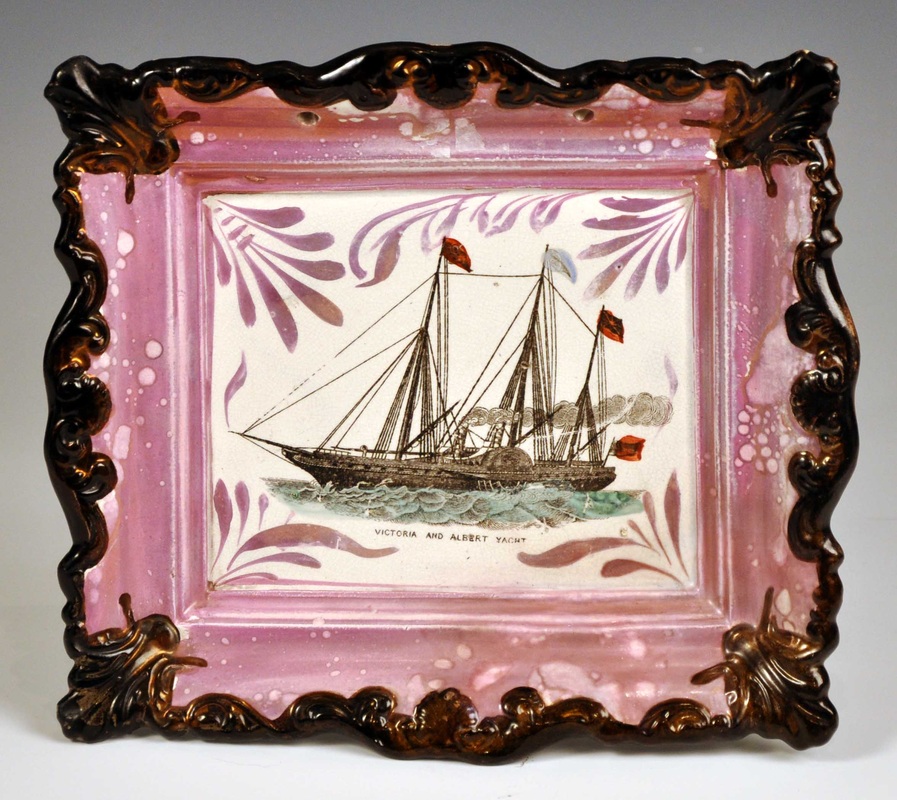
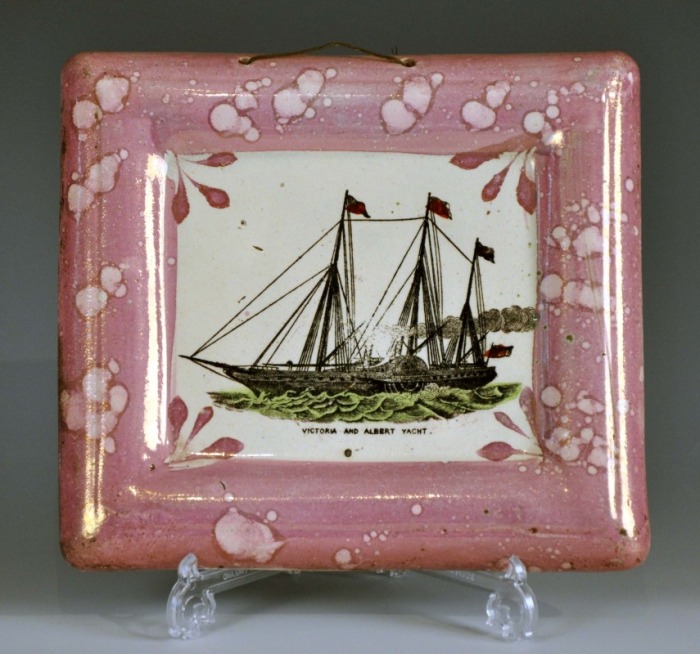
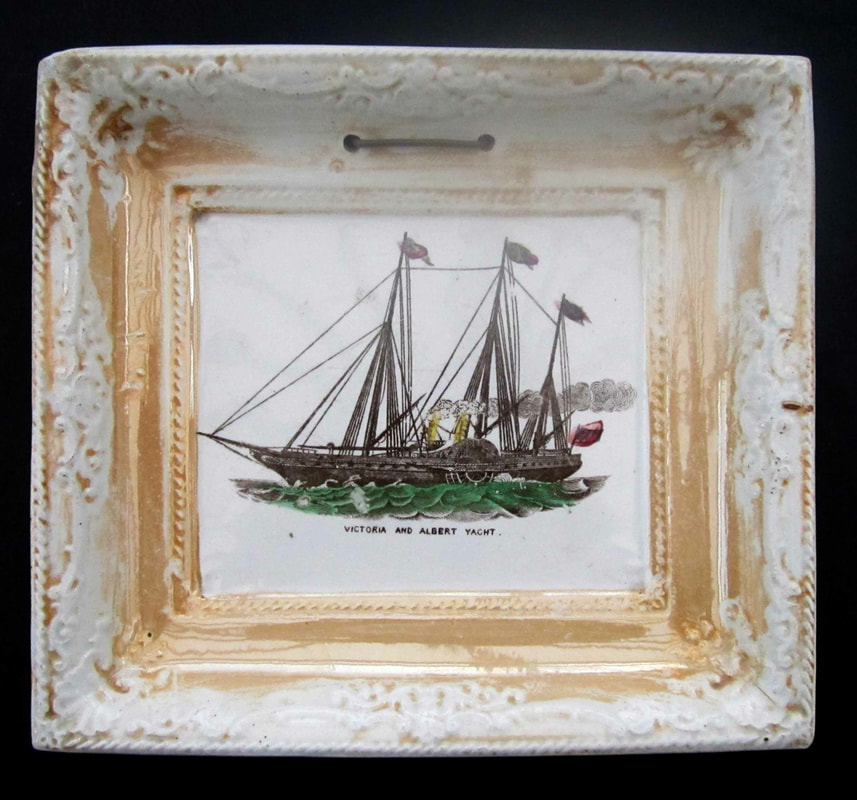
HMY Victoria and Albert II, was the second royal yacht to be steam powered, and took the name of her predecessor when she was launched on 16 January 1855. She was a 338 ft, wood-built paddle vessel, had a 240 crew, and her 600 HP engines could make 17 knots. Owned by the Navy, she was Queen Victoria's Royal Yacht until 1900, and scrapped around 1904.
http://en.wikipedia.org/wiki/HMY_Victoria_and_Albert_II
http://en.wikipedia.org/wiki/HMY_Victoria_and_Albert_II
Again, all the pink-lustre plaques above, although unmarked, are attributed to Moore's. The first is from the 1850s, and the others from the 1860s. The last pink plaque has a mould associated with Galloway and Atkinson at the Albion Pottery (Tyneside). Moore's appears to have acquired their plaque moulds after that partnership ended, c1864. The orange-lustre plaque is of a form attributed to Scott's, c1870.
Unidentified common ships
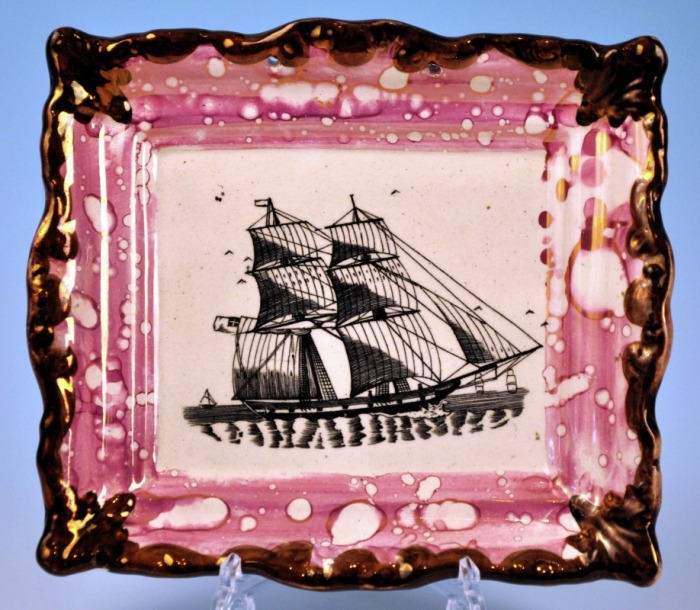
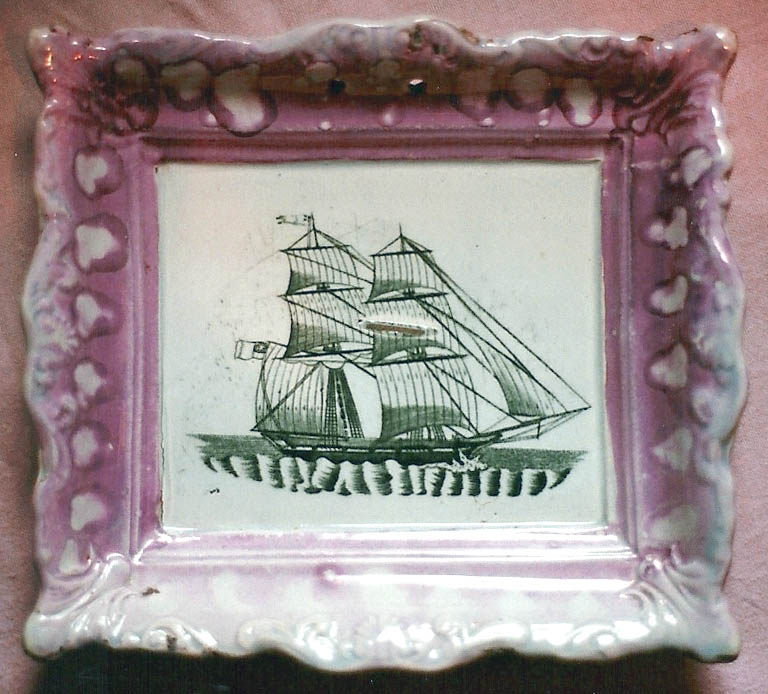

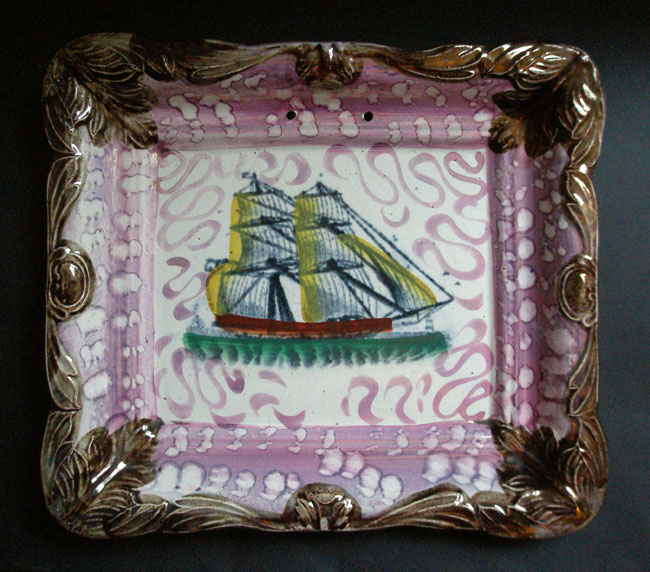
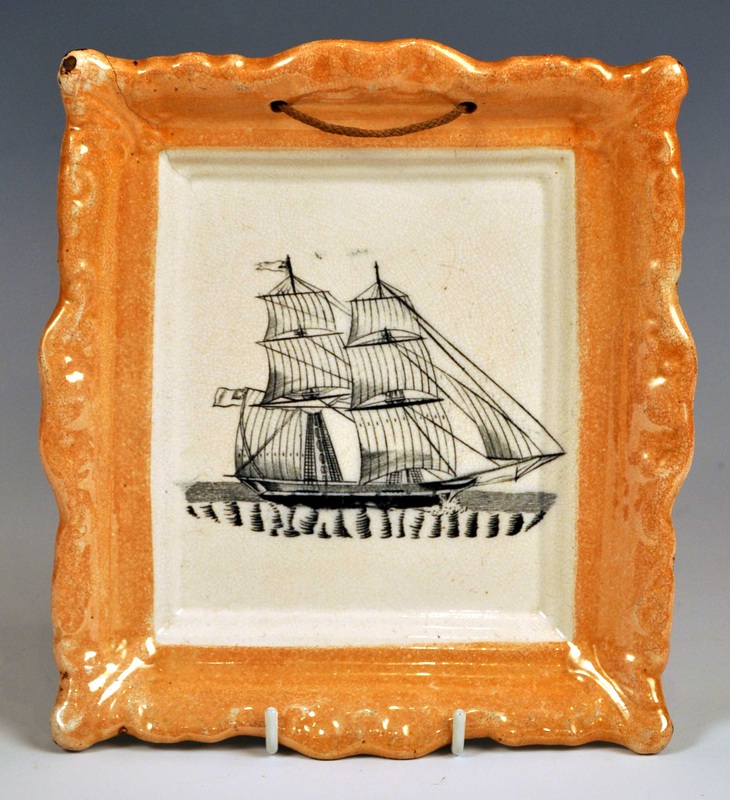

The three larger plaques attributed to John Carr's Low Lights Pottery, North Shields (read more here). The drawing of the ship is similar to that on rare plaques titled 'Gudrun', produced by Galloway and Atkinson at the Albion Pottery (1864). See the rare ships page.
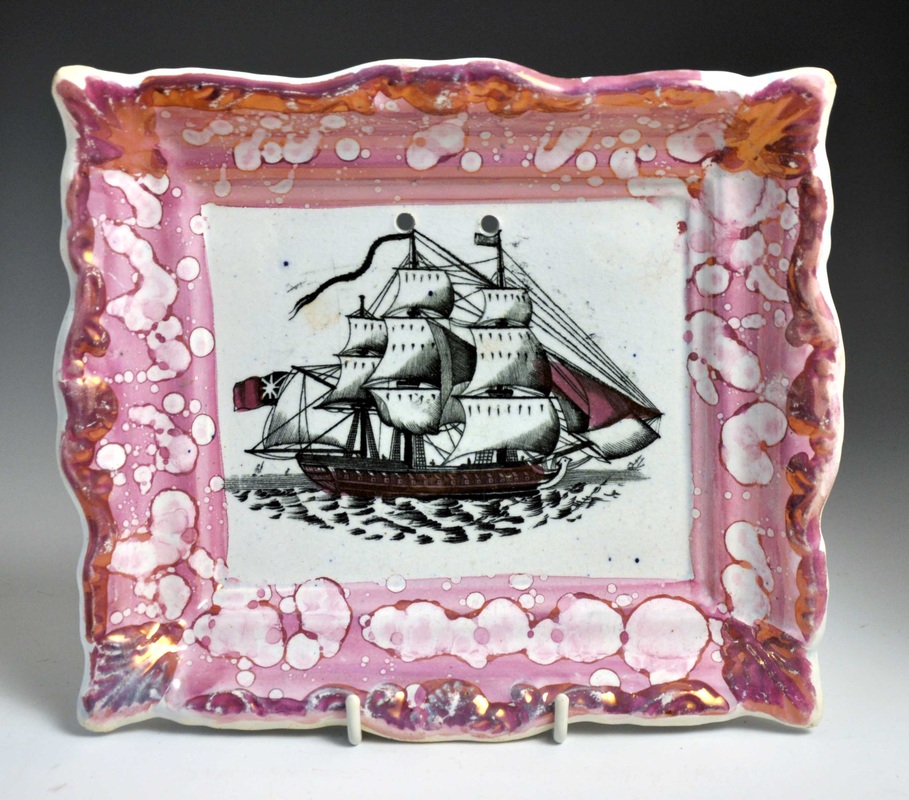

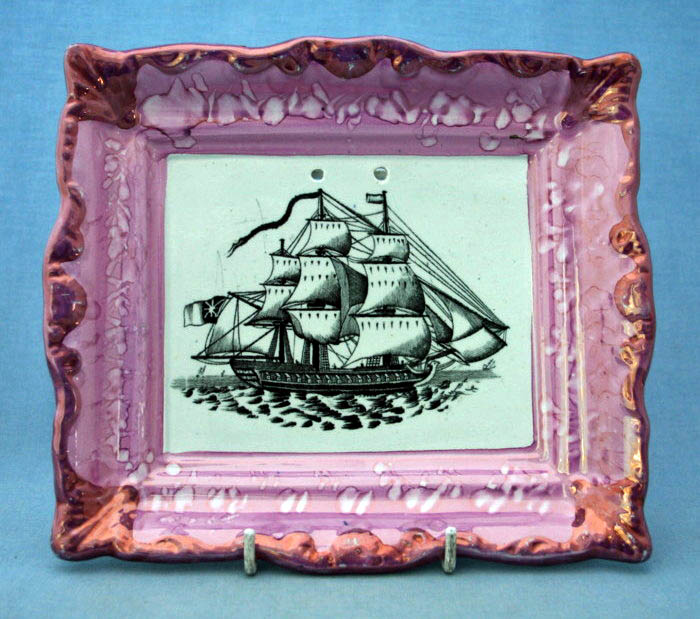
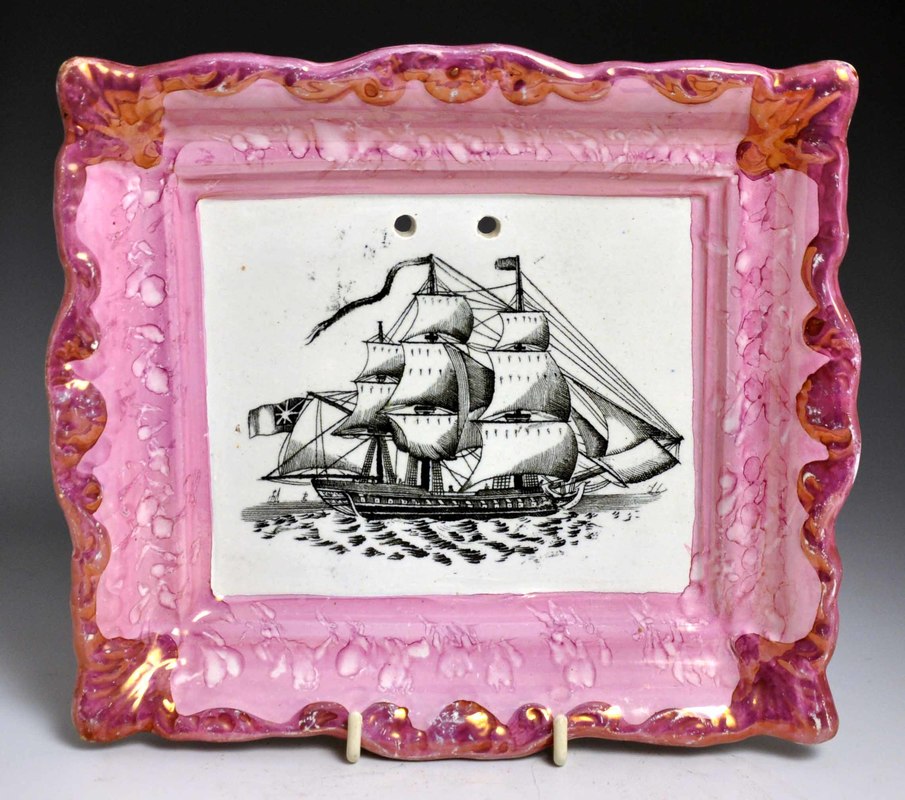
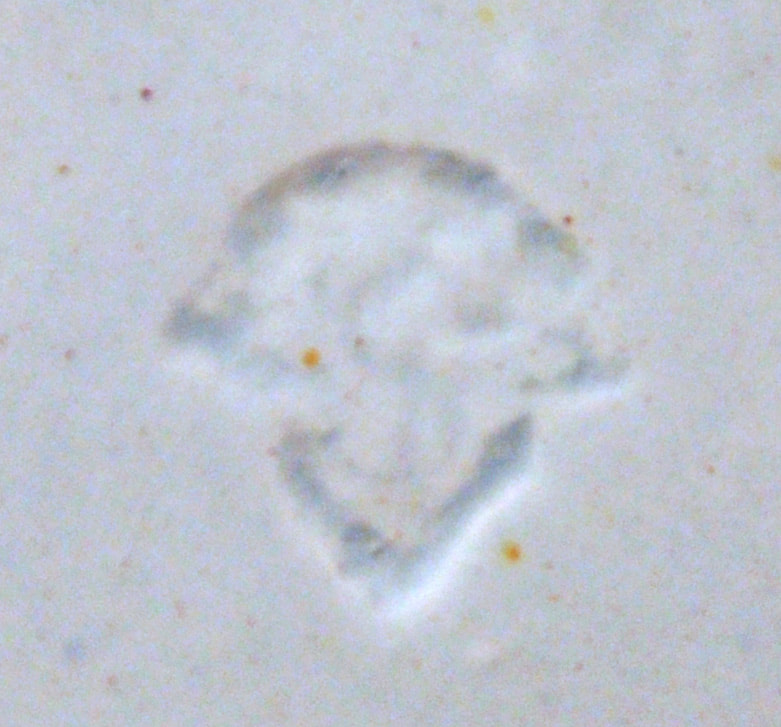
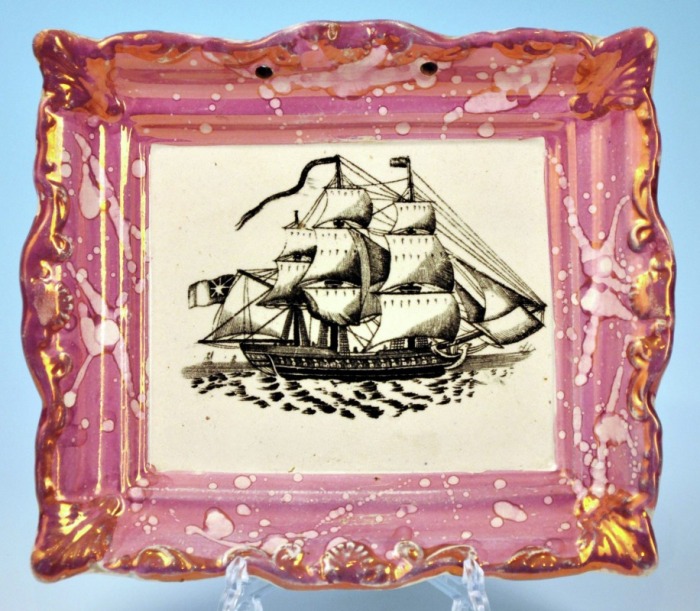
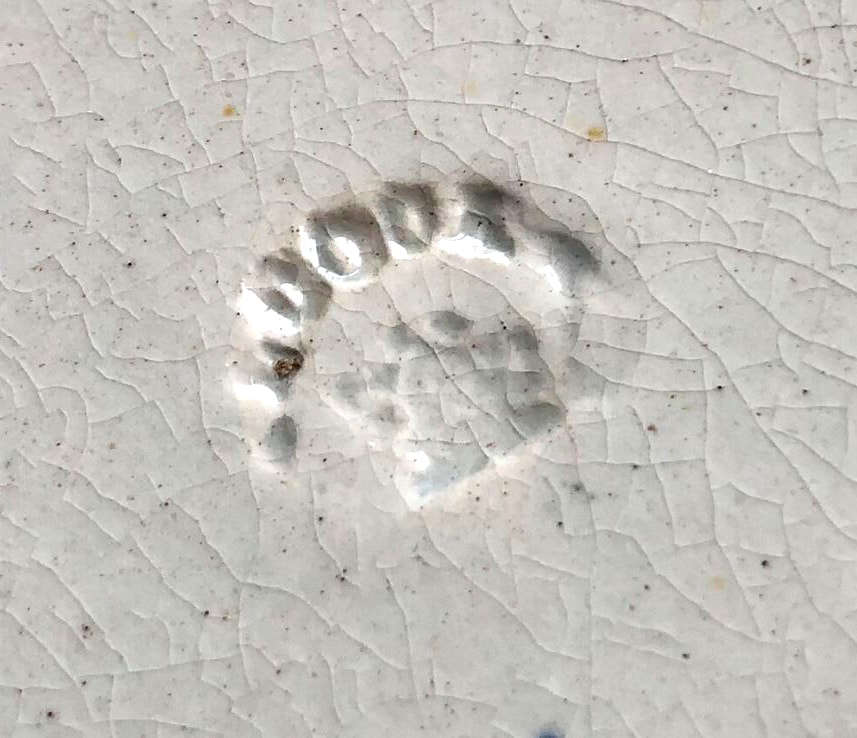
The first plaque has the impressed crown mark used by Thomas Fell (see centre), and lustre decoration to the transfer. The bottom left plaque has the London impressed mark, known to have been used by Fell. The first three plaques have the hanging holes pierced underneath the pink-lustre border - a feature of Fell plaques. The last plaque has a slightly different transfer. Maling is known to have used a variation of this transfer. See my other site for a comprehensive survey of jugs, bowls, etc with this transfer.
This is one of a number of Fell transfer plates that appears to have been purchased by the Staffordshire potter, Samuel Alcock & Co. Interestingly, the Staffordshire potter potter has put the hanging holes in the same place as Fell. See another here. Underneath the maker's name is an impressed beehive – a symbol of industry.
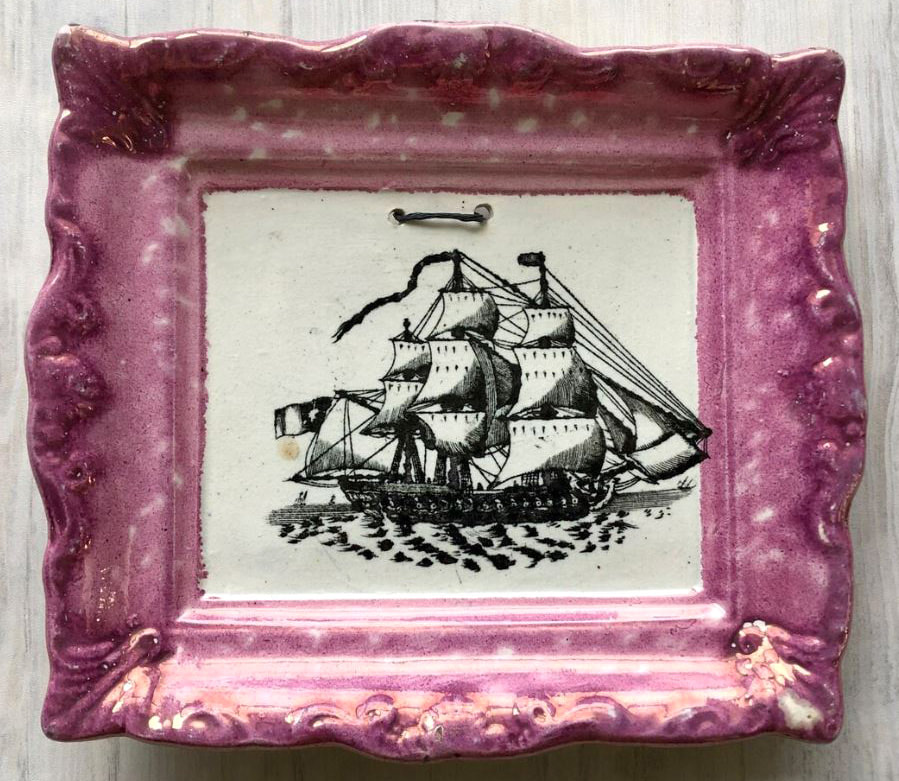
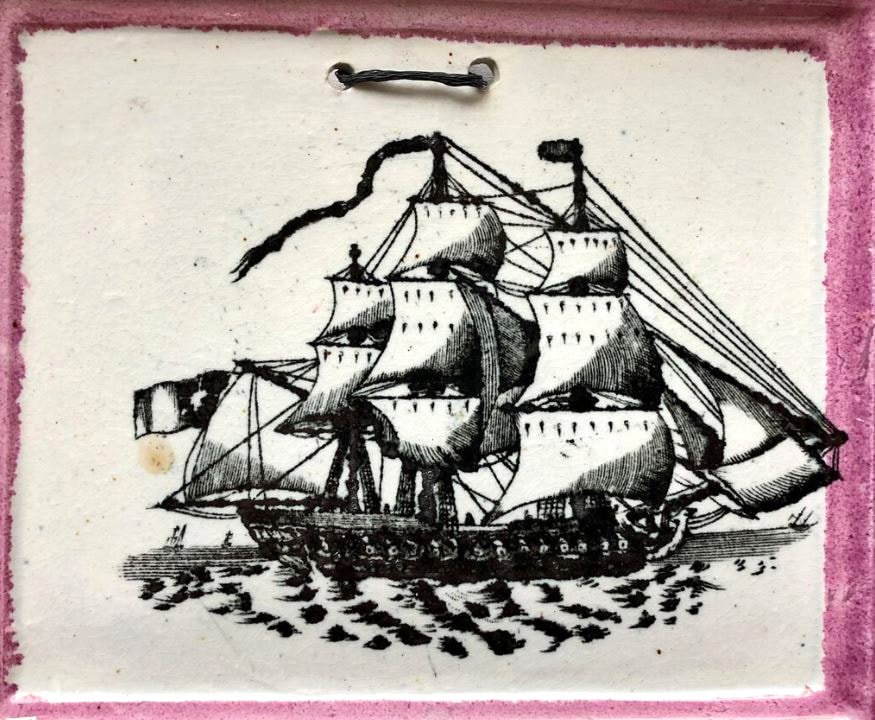
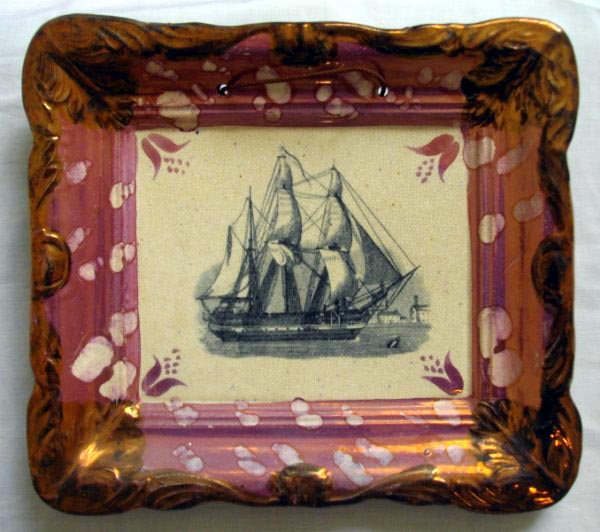


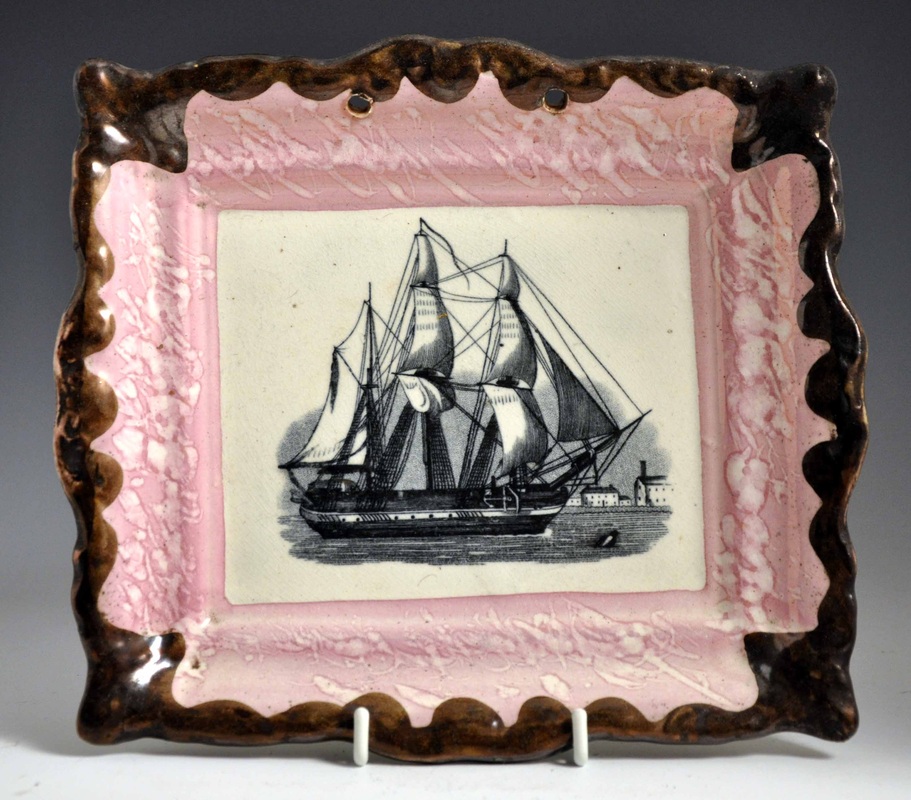
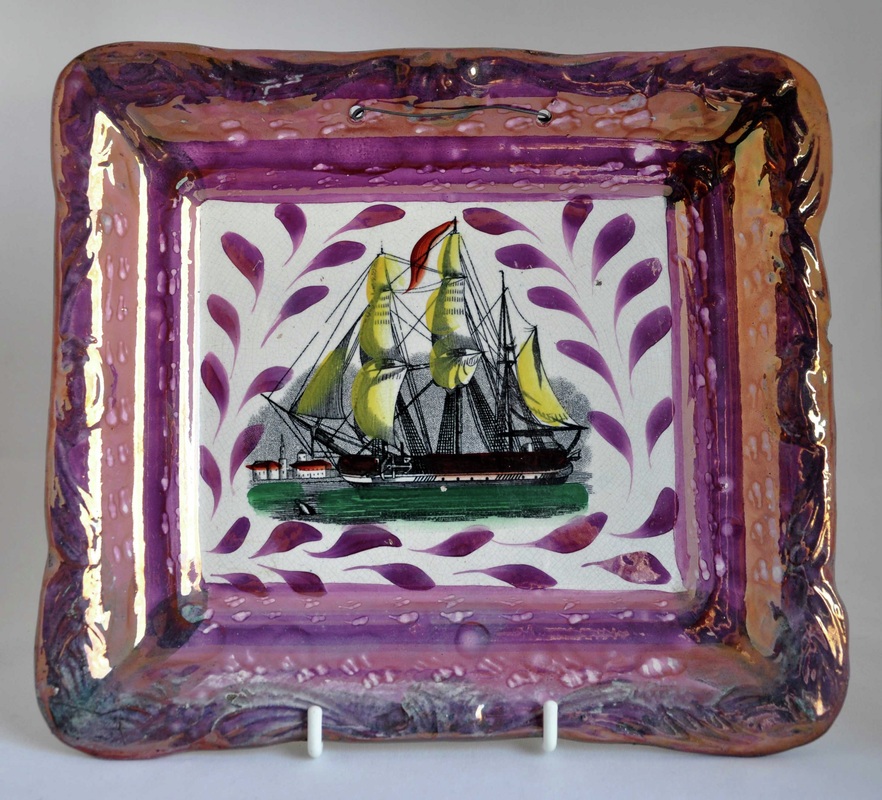
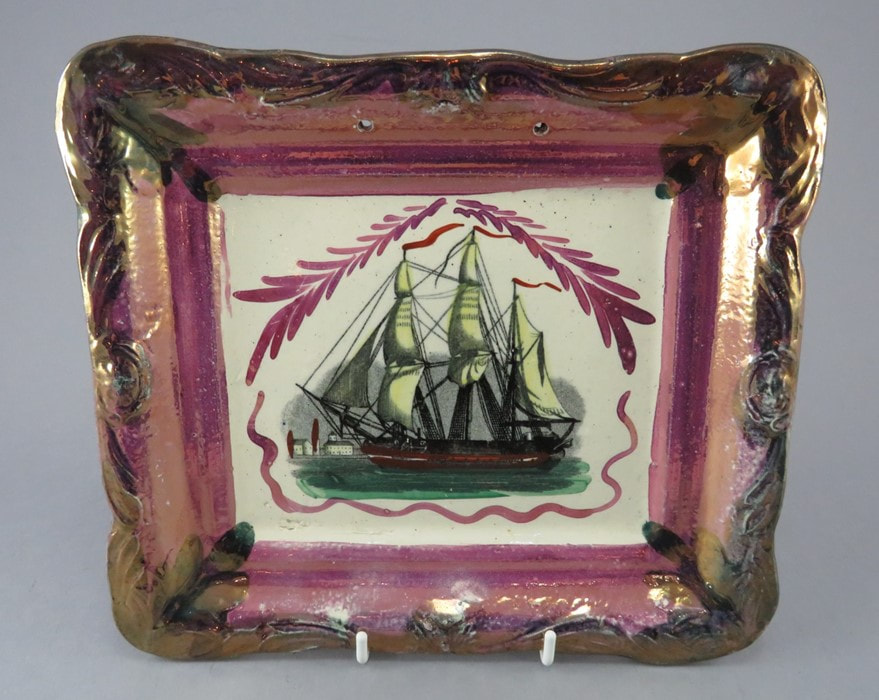
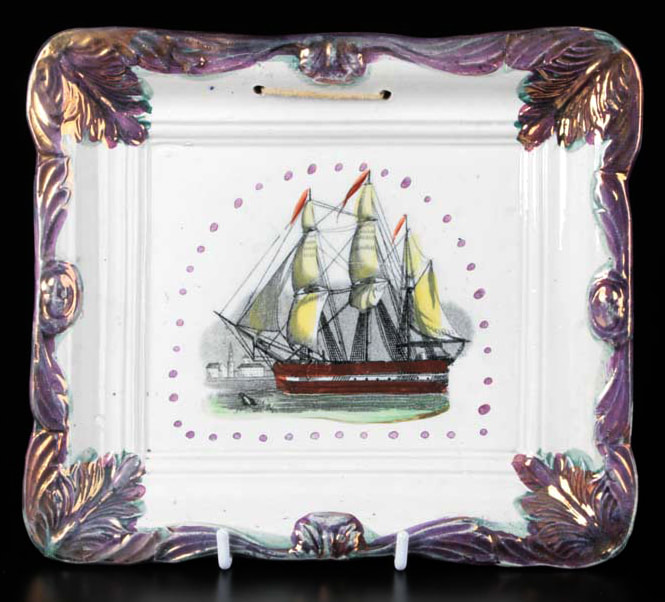
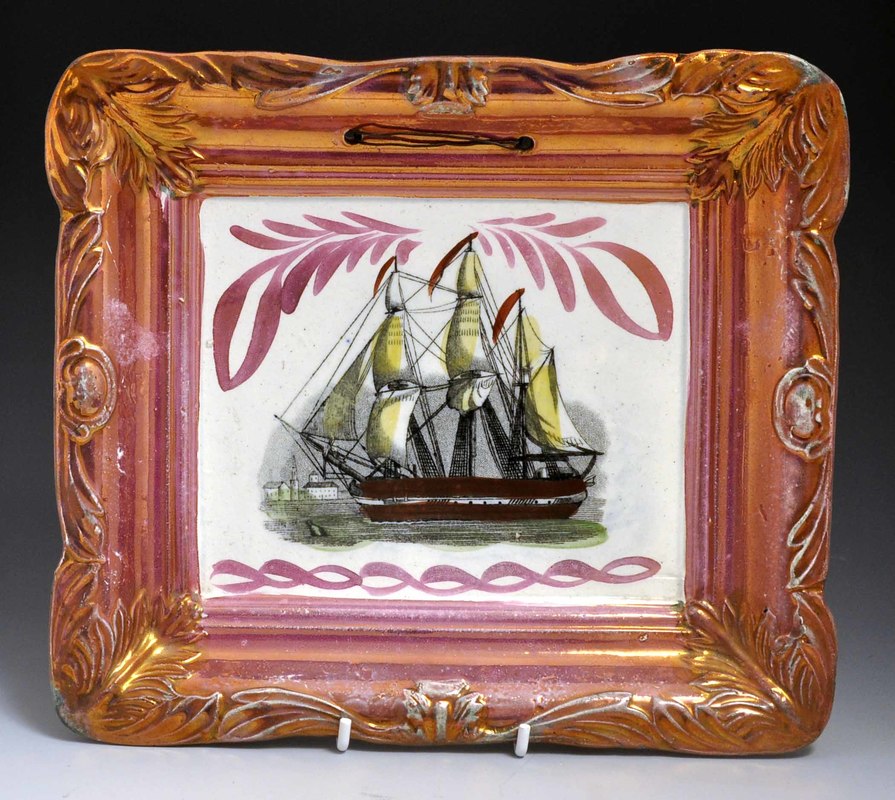
These plaques attributed to John Carr's Low Lights Pottery, North Shields (read more here). More rarely this transfer appears with the ship facing right (see left plaques), and sometimes paired with the more usual left-pointing ship. The smaller versions are much rarer.